Portfolio management services distribution is one of the few SEBI regulated activities in India where the certification exam itself is still quietly under searched. NISM Series XXI-A, the Portfolio Management Services Distributors Certification Examination, is mandatory for anyone distributing PMS products, yet most study content online is written for the older, more crowded NISM series. This guide covers the exam pattern, syllabus and preparation approach for Series XXI-A specifically.
Who needs this certification
NISM Series XXI-A is required for individuals engaged in selling or distributing portfolio management services on behalf of a SEBI registered portfolio manager. If your role involves onboarding PMS clients, explaining PMS products, or earning distribution commission on PMS assets, this certification applies to you under SEBI regulations.
Exam pattern
The paper runs two hours and carries 100 marks. It is built from 80 standalone multiple choice questions plus three case based questions drawn from real world PMS scenarios. The pass mark is 60 percent, and there is negative marking of 10 percent of the marks assigned to each question you get wrong, so guessing carelessly costs more here than on exams with no negative marking.
What the syllabus covers
Four broad areas make up most of the paper. The first is investment fundamentals: securities markets, equity and fixed income basics, derivatives and mutual funds, since a PMS distributor has to be conversant with the full range of instruments a portfolio manager might use. The second is the portfolio management process itself, including how portfolio managers construct, rebalance and report on portfolios, and how performance is measured and benchmarked. The third is PMS specific documentation: the disclosure document, client onboarding and KYC, and how a PMS agreement differs from a mutual fund folio or an AIF subscription. The fourth is the commercial side: fee structures, charges and how PMS compares with mutual funds and alternative investment funds on cost and structure, a comparison that comes up often in both the exam and in client conversations.
How to prepare
Start with the official NISM workbook for Series XXI-A rather than generic wealth management material, because the case based questions test the specific PMS process and disclosure requirements the workbook covers. Once you have read it through, switch to timed practice sets so you get used to working through case scenarios inside the two hour window. Because of the 10 percent negative marking, review your practice attempts for questions you guessed rather than reasoned through, and go back to that section of the workbook before you sit the real paper.
Frequently asked questions
Is NISM Series XXI-A the same as the NISM PMS exam for managers? No. Series XXI-A is for distributors. Managers and their key investment team are certified under a separate NISM series.
How long is the certificate valid? NISM certifications are typically valid for three years from the date of the exam, after which renewal or CPE requirements apply. Confirm the current validity period on the NISM website before you plan ahead.
Can I retake the exam if I fail? Yes, candidates can re register and reattempt the exam, subject to NISM’s standard cooling off period between attempts.
The February 2027 CFA Level I window runs February 22-28, registration closes November 5, and the scheduling deadline is November 10. Early-bird pricing has already passed.
That leaves you two decisions in the next six weeks: whether to register, and how to prepare so you actually sit the exam ready.
Decision 1: Register or Wait?
Take a diagnostic mock this week. It reveals your baseline and your three weakest topics in one afternoon
Count protected hours honestly. 300 study hours over 20 weeks means 15 hours per week. If your calendar cannot hold 15 hours, register for a later window instead of paying for guilt
Check the fees: standard registration is USD 1,140 with no enrollment fee for 2026 exams. Registration also unlocks the official curriculum, so registering early effectively buys you study time
Decision 2: The 20-Week System
Weeks 1-2: Diagnostic review and calendar block. Book fixed study slots like meetings; slots that exist on paper only produce paper progress
Weeks 3-10: First pass through all 10 topics, weighted by exam weight (FSA, Ethics, and Quant first) and your diagnostic gaps. End every topic with practice questions on the same day
Weeks 11-14: Second pass on weak areas plus timed question sets. Start an error log: not just what you missed, but why (concept, application, or timing)
Weeks 15-18: Full mock exams under real conditions. Review every mock for two hours per hour tested. Error patterns matter more than scores
Weeks 19-20: Taper. Formula sheets from your own errors, ethics re-read, light timed sets. No new material in the final two weeks
The system works because it’s built around checkpoints, not optimism. Every mock either confirms the plan or changes it.
The November FRM registration decision has a deadline: September 30. But paying the fee is not the same as being ready to sit the exam.
GARP lists Part I for November 14–20 and Part II for November 21–25. Before registering, give yourself one honest afternoon:
1. Take a timed diagnostic mock for your part. 2. Review every missed or guessed question. Is the problem an unfamiliar concept, an application error, or time pressure? 3. Count the study hours you can reliably protect each week, not the hours you hope to find.
If major areas are still untouched and that schedule cannot accommodate them, consider a later window. A mock score alone cannot predict a pass, but it can show whether your plan is realistic.
If November is viable, make the next six weeks count:
Weeks 1–2: Work through the largest gaps revealed by your mock. Follow each focused review session with practice questions.
Weeks 3–4: Switch to timed, mixed question sets. Keep an error log that records why you missed each question and what you will do differently.
Week 5: Sit another full mock under exam conditions. Compare the pattern of errors, not just the headline score.
Week 6: Revisit persistent weak spots and practise pacing. Avoid replacing targeted revision with a last-minute reread of everything.
One more date matters: GARP lists October 24 as the exam-appointment scheduling deadline. If you register, schedule your seat promptly.
Your best next step is a diagnostic, not another optimistic timetable. Explore FRM mock practice at https://financecertificationprep.in
Three certifications, three different clocks. Picking the wrong one does not just cost a fee — it costs the 90 days you could have spent on the right exam. Here is how to choose, and what to do in your first 90 days after choosing.
The Decision Tree: Start With the Role, Not the Trend
Long-horizon careers in investment management, equity research, or multi-asset roles: CFA. The broadest credential, three levels, roughly 300 study hours each. It is a marathon — plan years, not months
Risk management, treasury, or model-adjacent roles: FRM. Two parts, focused depth, highly respected inside risk teams
Selling, distributing, or advising in Indian markets: NISM. SEBI-mandated for the exact roles it covers — mutual fund distribution (V-A), equity derivatives (VIII), investment advice (X-A/X-B), research (XV). Weeks of preparation, immediate credential value
Now the part most candidates skip: match the exam to the clock that is actually running.
The Three Clocks Right Now
FRM November 2026: standard registration closes September 30 ($800 per part), Part I runs November 14-20. Only candidates already mid-preparation should attempt it. If you are starting from zero, target the next window instead
CFA Level I February 2027: registration closes November 5. This is the cleanest 90-day runway on the board — start studying in early November, sit a February exam
NISM: rolling computer-based windows all year, results within hours. No deadline pressure — but also no excuse; the only variable is when you start
The 90-Day Skeleton (Works for All Three)
Days 1-7: Sit a diagnostic mock before serious study. It tells you your starting baseline and which topics will need double blocks. Guessing costs you weeks; a mock costs you an afternoon
Days 8-60: Weighted topic attack. High-weight topics first — for CFA L1 that is FSA, Ethics, and Quant; for FRM P1 it is Valuation and Markets; for NISM, the modules your role actually touches. Set a weekly question quota (250-300 minimum) and never end a topic without same-day practice questions
Days 61-75: Checkpoint mock. Compare to the diagnostic. Flat score means your method needs fixing, not your effort
Days 76-90: Taper. Error-log review, formula sheets built from your own mistakes, light timed sets. No new material in the final two weeks — confidence comes from repetition, not novelty
The Real Decision Rule
Choose by the role you want in 2 years, register by the deadline you can actually meet, and let the diagnostic mock — not the calendar — set your intensity.
GARP does not publish its passing score. Survey estimates put it roughly in the 60-70% range, and it moves with every sitting. So chasing a specific number is guesswork — but reading your mock score properly is not.
Here is the framework for turning one full mock into your remaining study plan.
Step 1: Sort Every Wrong Answer Into 3 Buckets
Go through every miss and label it:
Concept gap — you never learned this material. The topic is genuinely unfamiliar
Application error — you knew the concept but could not execute: formula mix-ups, calculation slips, wrong tool for the question
Exam-skill error — misread the stem, ran out of time, second-guessed a correct answer into a wrong one
Three different problems. Three different fixes. Most candidates treat them all the same — re-read the topic — and that is why scores plateau.
Step 2: Apply the Right Fix Per Bucket
Concept gaps: targeted re-study of that specific reading only — not the whole book. Then 20-30 questions immediately to lock it in.
Application errors: no re-reading needed. Drill question volume on that topic. You know the concept; you need reps under time pressure.
Exam-skill errors: this is a behaviour fix, not a study fix. Timed mixed blocks, strict flag-and-move discipline, and a rule against changing answers without a concrete reason.
Step 3: Count Your Near-Misses
The questions you got right but flagged as a guess are weaknesses wearing a correct answer. Move them into the appropriate bucket. A 65% with 10 guessed answers is really a 55%.
Step 4: Set a Margin Target, Not a Pass Target
If the pass mark is somewhere in the 60s, aim for 70%+ on your next mocks. The buffer above the pass mark absorbs exam-day variance — harder questions, unfamiliar wording, nerves. Candidates who study to “just pass” have no room for a bad section.
Step 5: Sequence by Weight × Gap
Fix high-weight topics first: Part I, that is Valuation & Risk Models and Financial Markets & Products (~60% combined). Part II, it is Market, Credit, and Operational Risk (~20% each). A concept gap in a 20% topic outranks an application error in a 10% topic — always.
The Trap: Comfort Re-Reading
Re-reading familiar chapters feels productive and improves nothing. Every remaining hour should trace back to a bucket from your mock. If it does not, you are studying to feel busy, not to pass.
Your mock score is not a verdict — it is a map. Get one, read it properly, and spend your final weeks where the marks actually are.
Standard registration for the November FRM window closes September 30 at 11:59 PM ET. The fee is $800 per part. The early-bird $600 tier is long gone — closed July 31.
After September 30, your only options are late registration at a premium, or waiting until the May 2027 window. So the question every undecided candidate faces this week: is 8 weeks enough?
The Honest Answer: It Depends on One Test
Sit a diagnostic mock this week — before you pay the $800. The result tells you which candidate you are:
Scoring within 15-20% of the pass mark: 8 weeks is enough with a disciplined plan. Register
Scoring well below: registering anyway means paying $800 to feel productive. Wait for May 2027 — early registration for that window opens soon and saves you the late-fee math
A mock costs a fraction of the registration fee. It is the cheapest decision data you will ever buy.
If You Register: The 8-Week Sprint
Weeks 1-2: Diagnostic + triage. Tag every mock error by topic. Part I: Valuation & Risk Models and Financial Markets & Products are ~60% of the exam — these get the first and biggest blocks. Part II: Market, Credit, and Operational Risk at ~20% each are your three non-negotiables
Weeks 3-5: Volume. 40-50 mixed questions daily, timed. Every topic ends with same-day practice questions — reading without answering builds nothing. Error log running daily: topic, why you missed it, the fix
Weeks 6-7: Mock two and three. Same conditions every time. Your score trend between mocks is more honest than any study-hours count. Remaining weak spots get one focused session each — no broad re-reading
Week 8: Consolidation. Formula sheet from your error log only. Current Issues summaries for Part II — easy marks that candidates skip. No new material after Week 7. Sleep protected like it is part of the syllabus, because it is
One Deadline Inside the Deadline
Registration is not the last date that matters. Registered candidates must also schedule their exam appointment — the scheduling window for Part I closes October 24. A candidate who registers on September 30 and forgets to schedule has paid $800 for nothing. Register, then schedule the same day.
The candidates who pass November are not the ones who studied longest — they are the ones who started with a mock and aimed every remaining hour at the gaps it exposed.
The November FRM window is about 60 days out — Part I runs November 14-20, Part II runs November 21-25. And one date matters more than the exam itself: September 30 is the standard registration deadline. Miss it and the late fee is the cheap part.
If you are registered (or about to be), here is how 60 days converts into a pass.
Days 1-5: The Diagnostic
Sit a full mock for your part before touching the books seriously. Part I: 100 questions across Foundations of Risk, Quant, Markets, and Valuation. Part II: 80 questions across Market, Credit, Operational, Liquidity, Investment Risk, and Current Issues.
The mock tells you where your 60 days should go. Tag every wrong answer by topic — your study plan is now data, not guesswork.
Days 6-35: Weighted Topic Attack
Part I priorities (by weight): Valuation & Risk Models and Financial Markets & Products carry ~60% of the exam between them. Quant stays heavy on the basics — distributions, hypothesis testing, regression, VaR.
Part II priorities: Market, Credit, and Operational Risk are ~20% each — 60% of your exam in three topics. These get double sessions.
Rules for both parts:
High-weight, big-gap topics first — always
Finish every topic with 20-30 practice questions, same day. Reading alone does not build exam speed
Keep the error log running: topic, why you missed it, the fix. Patterns will emerge by Day 25
Days 36-50: Volume Phase
FRM rewards question volume. Target 50+ mixed questions daily in timed blocks. The exam tests application under time pressure — so practice must replicate it.
Days 51-53: Mock Two
Same conditions as the diagnostic. Your delta between the two mocks is your honest readiness signal. New weak spots get one focused session each.
Days 54-59: Consolidation
Current Issues and high-level concepts for Part II — easy marks candidates skip
Formula sheet built from your error log, not the whole curriculum
Ethics of risk governance and foundational concepts for Part I
No new material. Nothing you have not already seen
Day 60: Rest
Risk management includes managing your own fatigue. Sleep before a 4-hour exam is a strategy, not a luxury.
The Deadline Inside the Deadline
Registering before September 30 and studying like you have 90 days is how candidates fail a 60-day window. The countdown is real — start today with a diagnostic mock: https://financecertificationprep.in
Most candidates spend their last month re-reading notes they have already read. That is comfort studying — it feels productive and changes nothing.
Here is the alternative: a mock-first plan where every study hour is aimed at an actual weakness, not a felt one.
Day 1: The Diagnostic Mock
Sit a full mock exam under real conditions. Same duration, no phone, no pausing, closed book.
The score is not the point — the map is. Every wrong answer is tagged by topic. By evening of Day 1 you know your exam: which topics carry marks you are leaving on the table.
Days 2-10: Weighted Weakness Attack
Sort your weak topics by exam weight × gap size. That product is your priority list. Two rules:
High-weight, big-gap topics get hour blocks first — fixing Ethics gaps beats fixing Derivatives gaps at the same effort
Cap the plan at your 5 worst topics. More than that and you fix nothing properly
For each weak topic: one focused review of the concepts behind your errors, then 20-30 practice questions immediately after. Review without practice does not stick.
Days 11-20: Timed Practice Blocks
Switch from topic sets to mixed, timed blocks. Your brain must now do what the exam demands: identify the topic, choose the tool, and execute under the clock.
Keep the error log running. Every mistake gets one line: topic, why you got it wrong, the fix. By Day 20 you will see your error patterns — calculation slips, misread stems, concept gaps are three different problems with three different fixes.
Days 21-25: Mock Two
Second full mock, same conditions. This one measures whether the plan worked. Expect improvement on the attacked topics. New weak spots get one focused session each.
Days 26-29: Ethics and Formulas
Ethics daily, in small doses — 15-20 questions per day. Ethics is 15-20% of the exam and the tiebreaker on borderline results
Formula sheet from your error log — the formulas you actually got wrong, not every formula ever written
Light review only. No new material. Nothing after Day 25 that you have not seen before
Day 30: Rest
A tired brain fails a 4.5-hour exam. Sleep, food, logistics check, early night. The exam is won on the preparation you already did — Day 30 just protects it.
The One Mistake That Ruins This Plan
Skipping the Day 1 mock because “I’m not ready yet.” You are not supposed to be ready — the diagnostic is what builds the readiness. Candidates who mock early pass at higher rates because they spend the final month fixing reality instead of rehearsing hope.
For years, CFA candidates had a safety net: pay $449, defer your exam, try again next window. That safety net is being taken away.
CFA Institute has eliminated paid deferrals beginning with the 2027 exam cycles. Registration for 2027 windows has been open since May 2026 — and every booking made now is one you cannot pay to postpone.
Why CFA Institute Did This
The data told the story: candidates who deferred had consistently lower pass rates than those who sat their scheduled exam. The paid deferral was enabling the wrong behaviour — booking before you are ready, then buying time later.
What Is Actually Gone
The paid deferral ($449): previously, any candidate could postpone to a future window for any reason, once per exam cycle. From 2027, gone entirely.
If you miss your exam: your registration fee is forfeited. No carry-forward. No credit. You register fresh and pay again.
What Still Exists
Rescheduling within your window — move your appointment within the same window for the standard change fee (around $250), subject to seat availability
Emergency deferrals — qualifying hardships only: serious medical conditions, death in family, military deployment, natural disaster. Processing fee applies, deferral moves you up to 12 months out
The emergency route is deliberately strict. “Work got busy” does not qualify. Neither does “I wasn’t ready.”
Your Booking Discipline Checklist
Book when you are 90% confident, not when the early-bird deadline pressures you. The fee saving is smaller than a forfeited registration
Take a full mock exam before booking. Your mock score is your readiness evidence — not your optimism
If your prep looks uncertain in the months ahead, book the later window now rather than planning to defer later
If you must move, check reschedule options first — moving within the window costs a fraction of losing the registration
Read the emergency deferral criteria before you assume you qualify
The candidates hurt most by this change are the ones who treated deferral as part of their study plan. It was never meant to be that — and now it cannot be.
The New Rule: Book When Ready
The old system let you register on hope and pay for flexibility later. The new system demands honesty: register when your preparation supports the date you picked.
The best readiness test is a realistic mock under exam conditions. Our CFA Level 1 and Level 2 mock tests — with detailed report cards and answer explanations — tell you exactly where you stand before you commit a date: https://financecertificationprep.in
The CFA Program is having its biggest curriculum update in years — and it applies to every candidate sitting exams from February 2027 onward.
If you are registering for a 2027 window, your prep materials matter more than ever.
The Headline: AI Enters the CFA Syllabus
CFA Institute has added new readings on financial data science, artificial intelligence, and large language models. “Introduction to Big Data Techniques” is now “Introduction to Financial Data Science.”
Translation: the charter is catching up to how investment decisions get made in 2026 — data-heavy, model-driven, AI-assisted.
Level 1: The Biggest Shake-Up
Two topics were fully rebuilt — Quantitative Methods and Equities. Together they touch roughly a quarter of the Level 1 exam.
Quantitative Methods:
Reorganised around real-world applications, not abstract theory
More Q&A, knowledge checks, and targeted practice built into the readings
Shift toward building forecast models instead of memorising DCF formulas
Renamed from “Equity Valuation” to “Equities” — language now matches how the industry works
The topic weight ranges stay the same. The changes are inside the topics — how the material is taught, tested, and applied.
Ethics: New Structure, Same Standards
The 7 Standards of Professional Conduct are now split into 7 dedicated chapters — one per Standard. Same ethics content, clearer organisation. Expect more granular ethics questions as a result.
The Renames Across the Curriculum
Corporate Issuers → Corporate Finance
Equity Valuation → Equities
Portfolio Management → Portfolio Construction
Cosmetic, but useful — the curriculum now speaks the language you will hear on the job.
Level 2 and Level 3
Level 2: moderate updates, same topic weights. Level 3: practically unchanged. The real action is at Level 1.
What This Means for Your Preparation
Do not use pre-2027 materials for Quant and Equities — too much of the content changed
The new format rewards application over memorisation — practice questions matter even more
AI/data science readings are new territory for every candidate — no one has a head start, which is actually an opportunity
Retaking from 2026? Audit the changed readings first — do not assume your notes carry over
Exams with the new curriculum start February 2027. Candidates studying now are the first generation tested on AI concepts in CFA history.
Every stock recommendation you see — every research report from a brokerage — comes from someone who cleared NISM Series XV. It is the SEBI-mandated certification for research analysts. If you want a career analysing companies, building valuation models, and publishing views on stocks, this is your entry point.
The Exam Structure
100 questions. 100 marks. 2 hours. Pass mark: 60% — higher than Series V-A’s 50%.
The format is a mix: 80 multiple-choice questions (80 marks) plus 5 case studies with 4 questions each (20 marks). The case-based section tests application — you analyse a scenario and answer questions on it.
No negative marking. Certificate validity: 3 years.
The 13-Chapter Syllabus — Study by Weight
Highest weight (master these first):
Company Analysis — Quantitative Dimensions: 16%
Valuation Principles: 16%
These two chapters are 32% of the exam. Financial statement analysis, ratio analysis, DCF, relative valuation — the core analyst toolkit.
High weight:
Economic Analysis: 10%
Industry Analysis: 10%
Legal and Regulatory Environment: 10%
Medium weight: Company Analysis — Business and Governance (8%), Fundamentals of Research (5%), Corporate Actions (5%), Fundamentals of Risk and Return (5%), Introduction to Research Analyst Profession (3%), Introduction to Securities Market (4%), Terminology in Equity and Debt Markets (4%), Qualities of a Good Research Report (4%).
Study strategy: quantitative company analysis, valuation, economic, industry, and legal chapters carry 62% of the marks. Focus there first, then sweep the rest.
What This Certification Unlocks
Series XV is mandatory for anyone associated with a SEBI-registered research analyst firm — and for individuals registering as Research Analysts with SEBI.
After passing, the SEBI RA registration path:
Pass NISM Series XV (valid 3 years)
Meet qualification criteria — professional qualification or graduate degree plus relevant finance credentials
Apply to SEBI for RA registration with net worth certificate and compliance infrastructure
Once registered: you can legally publish research, give stock recommendations, and charge for analysis services
The Career Path
Research Analyst → Senior Analyst → Head of Research → Fund Manager or CIO.
Equity research is the classic launchpad into buy-side roles (mutual funds, PMS, AIFs), investment banking, and corporate finance.
Salaries: entry-level research analysts in India start at ₹6-12 lakh per year. With 4-5 years of experience and a track record, ₹25-40 lakh is realistic. Top-tier fund managers earn significantly more.
Why Series XV
Direct regulatory mandate — SEBI requires it for research roles
Teaches real analysis — valuation, financial statements, industry frameworks
Case-based questions — test application, not memorisation
Complements CFA — Series XV is the regulatory ticket, CFA is the depth
Fastest route into front-office markets roles
If V-A is the distribution door, XV is the research door. Pick based on the career you want — or clear both and keep every option open.
If you are preparing for the NISM Series XV Research Analyst Certification Examination in 2026, the paper you sit is not the paper most online guides describe. NISM issued a circular dated 5 December 2025 replacing the examination with a revised version, and the revised paper went live on 20 January 2026. The old content stopped being examinable on 19 January 2026. This guide sets out what the exam looks like now, what actually changed, and how to prepare for it.
NISM Series XV exam pattern 2026 at a glance
Questions: 100 in total, made up of 80 standalone multiple choice questions of 1 mark each and 5 case studies carrying 4 questions each
Maximum marks: 100
Duration: 120 minutes
Pass mark: 60 marks, that is 60 percent
Negative marking: 25 percent of the marks assigned to a question, for every wrong answer
Certificate validity: 3 years
Fee: Rs 1500 plus applicable taxes
Mode: computer based, at NISM authorised test centres across India
What actually changed on 20 January 2026
The headline change is the arrival of case based questions. Twenty of the hundred marks now come from five case studies, each carrying four questions. That is a fifth of the paper. Previously the entire examination was standalone multiple choice.
This matters more than the number suggests. A standalone question can usually be answered from recall. A case based question gives you a company situation, a set of numbers or an extract from a report and asks you to work through it. You cannot memorise your way past those twenty marks. Given the pass mark is 60 and there is negative marking of 25 percent on every wrong answer, a candidate who is strong on recall but weak on application can now fail a paper they would have cleared under the old format.
The test objectives and the workbook were both revised alongside the format. If you are studying from a workbook or a question bank published before December 2025, you are preparing for an examination that no longer exists. Check the edition before you start.
The syllabus, and where the marks sit
NISM frames the examination around a top down research process, and the syllabus follows that logic.
Securities markets foundation
The basics of the Indian securities market and the terminology used in equity and debt markets. This is the cheapest section to secure marks in, and the one candidates most often skim.
Economy and industry analysis
Macroeconomic variables and how they feed through to company performance, the sources of economic data, and the key drivers and information sources for industry analysis. Expect case studies here.
Company analysis
Both the qualitative dimensions, such as management quality, governance and business model, and the quantitative dimensions drawn from financial statements. This is the heaviest application section.
Valuation and corporate actions
Fundamentals of risk and return, valuation principles, and the rationale behind corporate actions. Case based questions frequently combine a valuation calculation with a judgement call.
The research report and the regulatory framework
What makes a research report defensible, and the obligations placed on research analysts under the SEBI Research Analysts Regulations, 2014. Passing this examination is a regulatory requirement under Regulation 7(2), so the regulations are examined on their own terms, not as background.
How to prepare for the revised paper
Three things follow from the format change.
Do not guess. With 25 percent negative marking, four wrong guesses cancel one correct answer. On a paper where the pass mark is 60, that arithmetic decides borderline results. Answer what you know, reason through what you can narrow down, and leave the rest.
Practise cases under time. Twenty marks of case work inside a 120 minute paper means the reading itself consumes time that recall questions do not. Candidates who have only practised standalone questions routinely run short at the end.
Diagnose by section, not by total score. A score of 55 tells you nothing useful. Knowing that you lost most of those marks in company analysis and valuation tells you exactly what to restudy.
Free NISM Series XV mock test
Set 1 of our NISM Series XV Research Analyst mock test is free and runs on the current pattern: 100 marks, 120 minutes, negative marking applied exactly as the real paper applies it. Every answer carries a written explanation, and the report card at the end splits your score by syllabus area so you can see where the marks went. Nine further sets are available if you want more practice.
There is no fixed annual exam date. NISM Series XV runs on demand at authorised test centres, and you choose your slot when you register on the NISM certifications portal. The date that matters in 2026 is 20 January, the day the revised examination replaced the old one.
How many questions are in the NISM Series XV exam?
One hundred questions worth one mark each: 80 standalone multiple choice questions and 5 case studies of 4 questions each.
Is there negative marking in NISM Series XV?
Yes. Every wrong answer costs 25 percent of the marks assigned to that question.
What is the passing score for NISM Series XV?
Sixty marks out of one hundred, that is 60 percent.
How long is the NISM Series XV certificate valid?
Three years from the date of passing. Revalidation is through the certification examination or the applicable CPE programme.
Who needs the NISM Series XV certification?
Anyone registered as a research analyst under the SEBI Research Analysts Regulations, 2014, individuals employed as research analysts, and partners of a research analyst who prepare or publish research reports or research analysis.
You cleared Level 1. You cleared Level 2. One exam stands between you and the charter — and it is unlike anything you have faced before.
The Level 3 February 2027 window runs February 18-21. Registration is open now — standard deadline November 5, 2026. Fees: $1,590 standard ($1,240 early bird has closed).
Here is what makes Level 3 different, and how to pass it.
The Format: Half the Exam Is Essay Writing
Level 3 is the first time you face constructed response questions. Half your exam is not multiple choice — you write out answers, calculations, and recommendations.
Structure: 22 question sets — 11 item sets (multiple choice, vignette-based) and 11 constructed response (essay) sets. Each worth 12 points. 20 scored. Two sessions of 2 hours 12 minutes.
Each session is a mix: either 5 essay sets + 6 item sets, or 6 essay sets + 5 item sets. The mix is not announced in advance — you must be prepared for both.
Why this changes your preparation: You can know the curriculum cold and still fail if you cannot write concise, structured answers under time pressure. Essay answers are graded against a rubric — partial credit exists, but only if you write what graders are looking for.
Topic Weights — Where the Marks Are
Asset Allocation: 15-20%
Portfolio Construction: 15-20% (includes your specialised pathway)
Private Markets — private equity, private debt, venture capital
Your pathway affects a portion of Portfolio Construction questions. Choose based on your career direction — but note all three cover the same common core.
2027 Curriculum Changes: Minimal
Good news if you have 2026 materials: Level 3 has practically no curriculum changes for 2027. The only notable update — Ethics standards are split into 7 dedicated chapters (one per Standard I-VII). Core topics carry forward unchanged.
Pass Rate and Study Hours
Level 3 pass rate: typically 48-50% — the highest of the three levels. But candidates who fail usually fail on the essay portion, not on knowledge.
Recommended study time: 400+ hours. That is 15-17 hours per week from now until February.
Your 5-Month Study Plan (September — February)
Month 1 (Sep): Asset Allocation (15-20%) and Portfolio Construction (15-20%). The two highest-weight topics — together 30-40% of the exam. Build your foundation here first.
Month 2 (Oct): Fixed Income (15-20%) and Wealth Planning (10-15%). These overlap with Asset Allocation — learn them together for efficiency.
Month 3 (Nov): Complete your pathway readings. Register by November 5 if not done — this is the hard deadline. Schedule your exam immediately. Start essay practice NOW — one constructed response set per week under timed conditions.
Month 4 (Dec): Remaining topics — Ethics, Economics, Derivatives, Trading, Performance. Lighter weights, but Ethics is 10-15% and cannot be skipped. Take your first full mock with essay grading.
Month 5 (Jan): Two more full mocks. Grade your essays against rubrics — identify where you lose points (usually: too verbose, missing the direct answer, poor time allocation). Weekly essay practice: 3+ constructed response sets per week.
Exam Week (Feb 18-21): No new material. Review your essay answer templates. Rest.
The Essay Strategy That Passes
Answer the question asked. Not the question you wish was asked. Graders score against a rubric.
Be concise. Bullet points and short sentences score as well as paragraphs — and save time.
Show your formula. Even if your arithmetic is wrong, correct methodology earns partial credit.
Watch the clock. Roughly 13 minutes per essay set. If you go over, move on.
Never leave an essay blank. Write something structured — partial credit is real.
Practice is the only way to master this. Reading about essay technique does nothing. You must write, get graded, and correct.
Know someone starting their CFA journey? Our CFA Level 1 and Level 2 mock tests — with detailed report cards, answer explanations, and a realistic exam interface — build the foundation that carries candidates through to Level 3. Explore them here: https://financecertificationprep.in
Three levels. One charter. Finish what you started.
Want to start earning in mutual fund distribution? NISM Series V-A is the mandatory certification — and it is one of the most accessible exams in Indian finance. Here is the complete roadmap from registration to your first commission.
The Exam Structure
100 multiple-choice questions. 1 mark each. 2 hours. Passing score: 50% — you need 50 correct answers.
Critical detail: NO negative marking. Attempt all 100 questions, even the ones you are unsure about.
The exam is computer-based at NSEIT/Mettl test centres. Results are available immediately — you know your score the same day.
The 12-Chapter Syllabus — Study by Weight
Not all chapters are equal. Here is where the marks are:
Chapters 8 and 10 alone account for 35% of the exam. Master taxation and risk-return metrics, and you are over a third of the way to passing.
Study strategy: Spend 60% of your time on Chapters 8, 10, 3, 4, and 9 — they cover roughly 70% of the exam. Practice numerical questions on NAV, TER, and taxation calculations.
After You Pass: The ARN Registration
Passing the exam is step one. To start distributing mutual funds and earning commissions, you need an ARN (AMFI Registration Number):
Pass NISM Series V-A with valid certificate (valid 3 years)
Apply for ARN through AMFI (via CAMS KRA)
Pay registration fee (approx ₹5,000 for individuals)
Receive ARN — co-terminus with your NISM certificate (3 years)
Empanel with AMCs to start selling their schemes
Minimum qualification: 12th pass. Age: 18+. That is it — one of the lowest entry barriers in financial services.
The Earning Model
Upfront commissions on new investments
Trail commissions — recurring income on ongoing AUM, typically 0.5-1% annually
Trail income compounds as your client book grows
New distributors typically earn ₹2.5 lakh+ in the first year. Established distributors with a ₹100 crore AUM book earn ₹50 lakh+ annually from trail alone. Your income grows with your client base — no ceiling.
Why This Certification Works
Mandatory by regulation — every mutual fund distributor in India needs it
50% pass mark with no negative marking — accessible but credible
3-year validity — renewable, keeps your knowledge current
Low entry barrier — 12th pass, minimal investment
Immediate earning potential — start commissions within weeks of passing
Whether you are a student exploring finance careers, a professional adding a revenue stream, or an entrepreneur building a distribution business — Series V-A is the entry ticket.
CFA November 2026 registration is closed. The next Level 1 window is February 2027 (Feb 22-28). Registration is open now — but the standard deadline is November 5, 2026. After that, you miss this window entirely.
Early bird fee: $1,140. Standard fee: $1,490. You save $350 by registering now. That gives you 5 months to prepare — here is your plan.
Exam Format
180 multiple-choice questions. Two sessions of 135 minutes each. 90 questions per session. 10 topics. Plus one mandatory Practical Skills Module (PSM).
Pass rate: approximately 40%. Recommended study time: 300 hours. That is 15 hours per week over 5 months.
2027 Curriculum Changes — What Is New
The 2027 Level 1 curriculum has the biggest changes in years:
Quantitative Methods: Full reorganisation. Prerequisite readings dropped. New AI and Financial Data Science reading added. Weight changed to 11-14% (up from 6-9%).
Equities: Renamed from Equity Investments. Expanded from 8 to 12 learning modules. Significantly updated content.
Ethics: Restructured — one dedicated module per Standard (I-VII).
Derivatives: Weight changed to 6-9% (down from previous).
Alternative Investments: Weight adjusted.
All other topics: Minor edits, same weights.
Topic Weights — 2027
Ethics: 15-20%
Quantitative Methods: 11-14% (increased)
Economics: 6-9%
Financial Statement Analysis: 11-14%
Corporate Issuers: 6-9%
Equities: 11-14% (expanded)
Fixed Income: 11-14%
Derivatives: 6-9% (decreased)
Alternative Investments: 7-10%
Portfolio Management: 8-12%
The five 11-14% topics (Ethics, Quant, FSA, Equities, Fixed Income) account for roughly 55-70% of your exam.
Your 5-Month Study Plan (September — February)
Month 1 (September): Register now. Start with Ethics (15-20%) and Quantitative Methods (11-14%). Most-changed, highest-weight topics. 15 hrs/week.
Month 2 (October): Financial Statement Analysis (11-14%) and Equities (11-14%). Expanded Equities curriculum needs extra time — 12 modules. 15 hrs/week.
Month 3 (November): Fixed Income (11-14%) and Portfolio Management (8-12%). Register by November 5 if not done — last chance for Feb window. Schedule exam immediately. 15 hrs/week.
Month 4 (December): Economics, Corporate Issuers, Derivatives, and Alternative Investments (all 6-10%). Do not over-invest here — lower weight. 12 hrs/week. Start your PSM.
Month 5 (January): First full mock in week 1. Score by topic. Build error log. Second mock in week 3. Final review of weak areas in week 4. Complete your PSM by end of month. 15+ hrs/week.
Exam Week (Feb 22-28): No new material. Light review of error log only. Rest the day before.
Practical Skills Module — Mandatory
Choose one: Analyst Skills, Python Programming, Data Science, or Excel. 10-20 hours. Complete before exam day — your result is withheld until done.
3 Rules for Level 1 Success
Study by topic weight. Ethics + Quant + FSA + Equities + Fixed Income = 55-70% of your exam. Spend 65% of your time on these five.
Take 3+ full mocks. Candidates who take 3+ mocks pass at significantly higher rates.
Register before November 5. The standard deadline is your last chance. After that, the next window is May 2027 — 3 more months of waiting.
Register now. Start studying today. Pass in February.
If you passed CFA Level 1 in August 2026, your next step is Level 2 — and the May 2027 window (May 18-22) is the earliest available. Registration is now open. That gives you 8 months. Here is how to use them.
Level 2 is a different beast from Level 1. The format changes. The pass rate drops to 39%. The depth increases. Here is everything you need to know.
The Format Change: Item Sets and Vignettes
Level 1 uses standalone multiple-choice questions. Level 2 uses item sets — each set starts with a vignette (a 1-2 page case study with financial data, tables, and scenarios), followed by 4 multiple-choice questions tied to that case.
You cannot answer Level 2 questions without reading the vignette first. This means reading comprehension and data extraction are as important as concept mastery.
Exam structure:
88 questions total (down from Level 1’s 180)
22 item sets — 11 per session, 4 questions each
Two sessions of 2 hours 12 minutes each
1 item set per session is unscored (trial questions)
Topics are randomly distributed across both sessions
Topic Weights — 2027 (Unchanged from 2026)
High-weight topics (10-15% each):
Ethics
Financial Statement Analysis
Equity Investments (renamed Equities in 2027)
Fixed Income
Portfolio Management (renamed Portfolio Construction in 2027)
Low-weight topics (5-10% each):
Quantitative Methods
Economics
Corporate Issuers (renamed Corporate Finance in 2027)
Derivatives
Alternative Investments
The five high-weight topics account for 50-75% of your exam. Study accordingly.
Pass Rate and Study Hours
Level 2 pass rate: approximately 39% (vs Level 1’s 43%). Less than 4 in 10 candidates pass.
Recommended study time: 350+ hours (vs 300 for Level 1). That is roughly 10-12 hours per week over 8 months — or 15 hours per week if you start in October.
2027 Curriculum Changes for Level 2
Minimal changes — good news if you have 2026 materials as reference:
Ethics restructured from 3 to 9 learning modules (one module per Standard I-VII)
Three topic renames: Corporate Issuers to Corporate Finance, Equity Investments to Equities, Portfolio Management to Portfolio Construction
All other topics carry forward with minimal edits
Topic weights unchanged
Your 8-Month Study Plan (September 2026 — May 2027)
Months 1-2 (Sep — Oct): Foundation Start with the five high-weight topics. Read Ethics, FSA, Equities, Fixed Income, and Portfolio Construction. 12-15 hours per week. Take notes. Do end-of-reading practice questions.
Month 3 (Nov): Low-Weight Topics Cover Quant, Economics, Corporate Finance, Derivatives, and Alternative Investments. 12-15 hours per week. These topics are 5-10% each — do not over-invest time here.
Month 4 (Dec): First Review Pass Revisit all 10 topics. Focus on weak areas. Start practicing item sets — get used to reading vignettes under time pressure. 4 minutes per question is your target pace.
Month 5 (Jan): First Full Mock Take a full mock exam under timed conditions. Score topic by topic. Build an error log. Identify your 3 weakest topics. 15+ hours this month.
Month 6 (Feb): Targeted Weakness Review Drill your 3 weakest topics. 100+ practice questions each. Continue weekly item set practice. Start your second mock by end of month.
Month 7 (Mar): Second Full Mock Take mock 2. Compare with mock 1. Track improvement per topic. Review error log. Start your Practical Skills Module if not done.
Month 8 (Apr — May): Final Phase Take mock 3 in early April. Final error log review. Stop reading new material by mid-April. Practice item sets daily. Rest the final week before your exam window.
Practical Skills Module — Mandatory
Level 2 requires one PSM (10-20 hours): Analyst Skills, Macro Insights, or Portfolio Construction. Choose after registration. Complete before exam day — your result is withheld until done.
3 Rules for Level 2 Success
Practice item sets early. Reading a vignette and extracting relevant data is a skill. It takes 4-6 weeks of practice to get efficient. Start in Month 4, not Month 7.
Study by topic weight. The five 10-15% topics are 50-75% of your exam. Spend 70% of your time on them.
Take at least 3 full mocks. Level 2 is as much about time management as knowledge. Candidates who take 3+ mocks pass at significantly higher rates.
You are at the kitchen table with the laptop open and a cup of something that went cold an hour ago.
You are reading about derivatives for the third time this month. Binomial trees, risk neutral probabilities, the hedge ratio, why the up factor is what it is. You have understood it twice already and it has slipped both times.
You are reading it because your last mock put that chapter in red, and red means weak, and weak means read it again. That is the deal. That is what you signed up for when you registered.
Here is what nobody tells you at 11:40 on a Tuesday.
There is a decent chance that chapter was never your problem. And the marks that are actually draining out of your score, the ones that will decide this in six weeks, are coming from a chapter your report card left in unremarkable amber, and which you have not opened since.
You are not underworking. You are working precisely, carefully, and in the wrong place.
The question we went looking for
We kept seeing the same pattern. A candidate takes a mock, gets a weak areas list, revises it honestly for a fortnight, takes another mock, and lands within a couple of marks of where they started.
Not everyone. But often enough that “just put in more hours” stopped being a satisfying answer.
So we went digging, and the answer turned out to be sitting inside the report card itself. Not in the numbers it showed. In the question it was answering.
Every mock test platform in this market, ours included until recently, tells you which chapters you got wrong.
Not one of them tells you why.
And that turns out to matter enormously, because there is not one way to get a question wrong. There are four.
Four ways to lose the same mark
Picture four candidates. All four get the same question wrong. All four get the identical red flag on the identical chapter.
The first one did not know it. Never properly learned it. The material is the problem.
The second one knew it perfectly well. She could explain it to you over coffee. But in the hall, with the clock running, she could not pull it out of her head fast enough, second guessed herself, and picked the wrong option. She does not have a knowledge gap. She has a retrieval speed gap.
The third one knew it and was racing. Read the question too fast, missed the word “not”, answered a question that was not asked.
The fourth one never saw the question. Ran out of time on page four and never reached page seven. She might have got it right. Nobody will ever know, least of all her.
Four people. One red flag. Four completely different problems.
Now read the advice their report cards gave them. All four were told to revise the chapter.
Revision helps exactly one of them. For the second, rereading is close to useless, because more understanding is not what she lacks. For the third, it is worse than useless, because it sends him away from the habit that is actually costing him. For the fourth, it is beside the point entirely.
This is why two honest evenings can produce no improvement at all. Not because you did not work. Because the work was aimed at the wrong thing.
The thing nobody was measuring
So how do you tell four people apart when their scores are identical?
You measure the one thing every mock test throws away.
Time.
Not the total on the clock at the end. Time per question. Which questions you laboured over, which you flew past, and which you came back to twice because something about them nagged at you.
That number is the missing half of the diagnosis. Score tells you what happened. Time tells you why.
A chapter you got 40 percent on in 25 minutes and a chapter you got 40 percent on in 4 minutes are not the same chapter. One of them needs studying. The other needs you to slow down and read the question properly. Until now, no report card could tell you which was which, because none of them were watching the clock.
So we started watching it.
The two by two
Score alone could never separate your four candidates. Time alone could not either. A candidate who is slow might be struggling or might be careful. You cannot tell.
But put the two together, on two axes of the same chart, and they fall apart from each other instantly.
That chart is a two by two matrix, and it is now the first thing you see when you end a paper.
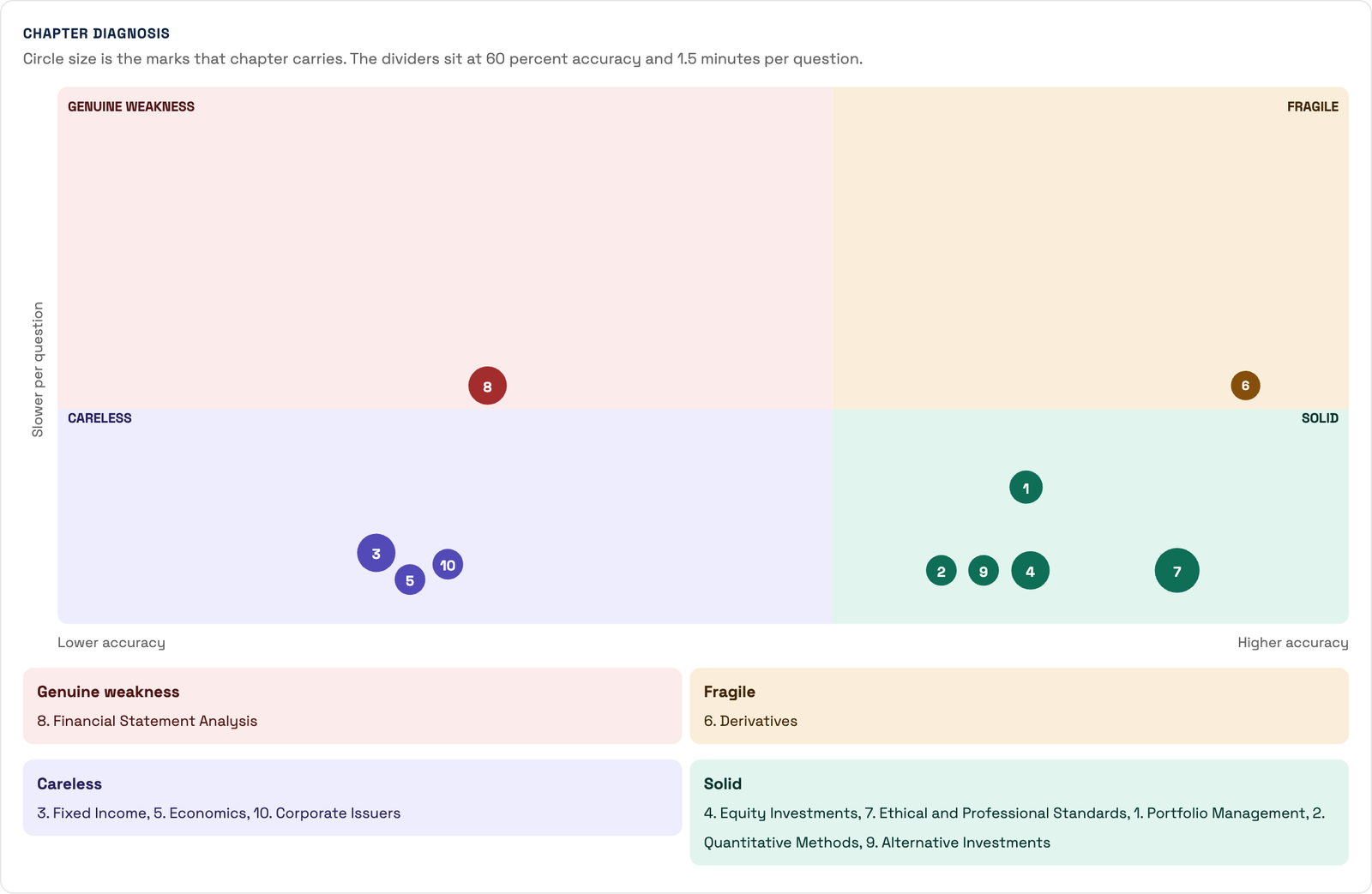
An actual CFA Level 1 report card from our platform. Financial Statement Analysis sits in genuine weakness, Derivatives in fragile, and Ethics, Equity and Portfolio Management are all solid and finished with.
Accuracy runs across the bottom. Further right, more of it right.
Time per question runs up the side. Higher up, longer per question.
Every chapter is a circle on it, sized by the marks that chapter carries. A 15 mark topic is a big circle. A 6 mark topic is a small one. So the areas that will actually decide your result are the ones your eye lands on first, which is something a table has never once done for you.
Two lines cross the middle. The vertical one sits at the accuracy you need. The horizontal one sits at the pace the paper allows, which is simply the time limit divided by the number of questions. On CFA Level 1 that is 135 minutes across 90 questions, so 1.5 minutes each.
Four quadrants. And now watch what happens to your four candidates.
Top left. Slow and wrong. This is your first candidate, the one who never properly learned it. Genuine weakness. The material is the problem, and this is the only quadrant on the entire chart where opening the study notes is the right response.
Top right. Slow and right. Your second candidate, the one who could explain it over coffee but froze with the clock running. Fragile. On a percentage table she looks like a strength, which is exactly what makes her dangerous, because in the hall that hesitation becomes a wrong answer. Drill her for speed. Do not send her back to the chapter she already understands.
Bottom left. Fast and wrong. Your third candidate, racing, missing the word “not”. Careless. No knowledge gap whatsoever. The fix costs him no study time at all. It costs him thirty seconds a question.
Bottom right. Fast and right. Solid.
Your fourth candidate, the one who never reached the question, does not appear on this chart at all. She gets a line of her own further down, and it is the one that tends to surprise people most.
Four candidates who had identical report cards ten minutes ago, standing in four different quadrants, each holding different instructions.
The quadrant nobody looks at
The bottom right deserves a moment, because it is the one every candidate scrolls straight past and it is the one that changes your fortnight.
Fast and right means you have this. Under time pressure. Cold.
Every hour you spend there is an hour taken from somewhere that is genuinely costing you marks.
Every report card in this market is built to tell you what to study. Almost none of them will tell you what to stop studying. And when you are six weeks out, holding down a full time job, and rationing evenings, being told to walk away from something is worth more than being handed another list.
The derivatives chapter you have been rereading since Tuesday. There is a real chance it is sitting in the bottom right, solid and fast and long since handled.
The arithmetic underneath
There is one more thing the chart fixed, and it hides in how weak areas get ranked.
The standard topic table sorts by percentage. Lowest score at the top, in red. It sounds obviously correct.
Run the numbers on a hundred mark paper.
Chapter 1 is worth 5 marks. You scored 20 percent. Alarming. Straight to the top of your list.
Chapter 3 is worth 20 marks. You scored 45 percent. Middling. Sits quietly in the middle where you ignore it.
Chapter 1 cost you 4 marks. Chapter 3 cost you 11.
Chapter 3 is close to three times the problem, and your report card sent you to Chapter 1.
This is not a curiosity. It happens on every paper where chapters carry different weights, which is every paper worth sitting. CFA Level 1 gives Ethics roughly triple the weight of Derivatives. NISM Series VII puts 20 marks on broking operations and 5 on the introductory chapter. A percentage column flattens all of that into a single misleading ranking.
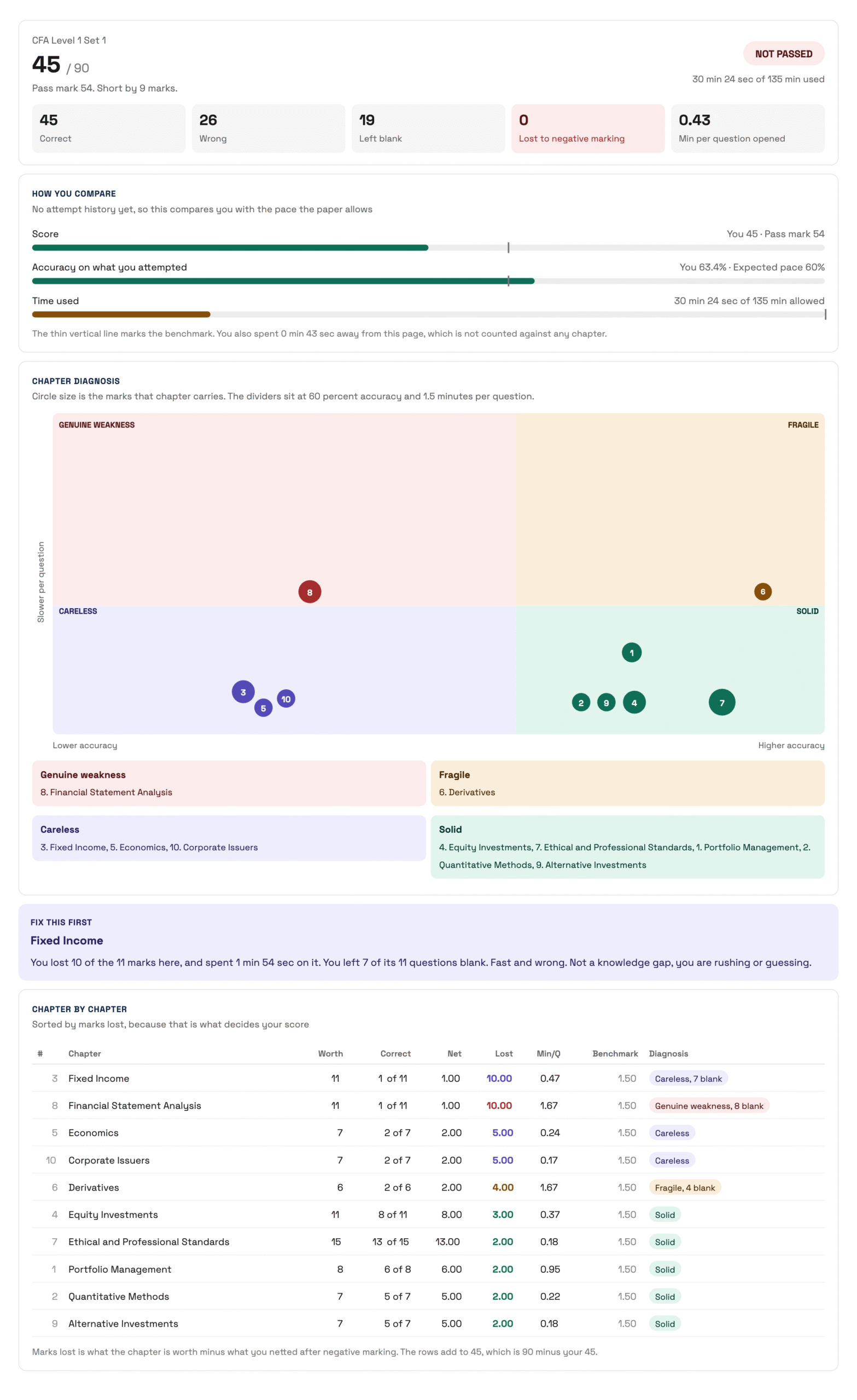
So the table under the chart ranks by the marks you actually lost, after negative marking. The chapter at the top is the one that cost you most, with a plain line telling you why it is there.
And what your blanks were really worth
“You left 6 questions unanswered” is a count. It tells you nothing.
“Those 6 were worth 8 marks, they sat in a chapter where you were getting 80 percent right, and you ran out of time before you reached them” is an entirely different sentence. It tells you that you had no knowledge problem there at all. You had a pacing problem, and it cost you 8 marks you were fully capable of earning.
Candidate four, the one who never appeared on the matrix, finally visible.
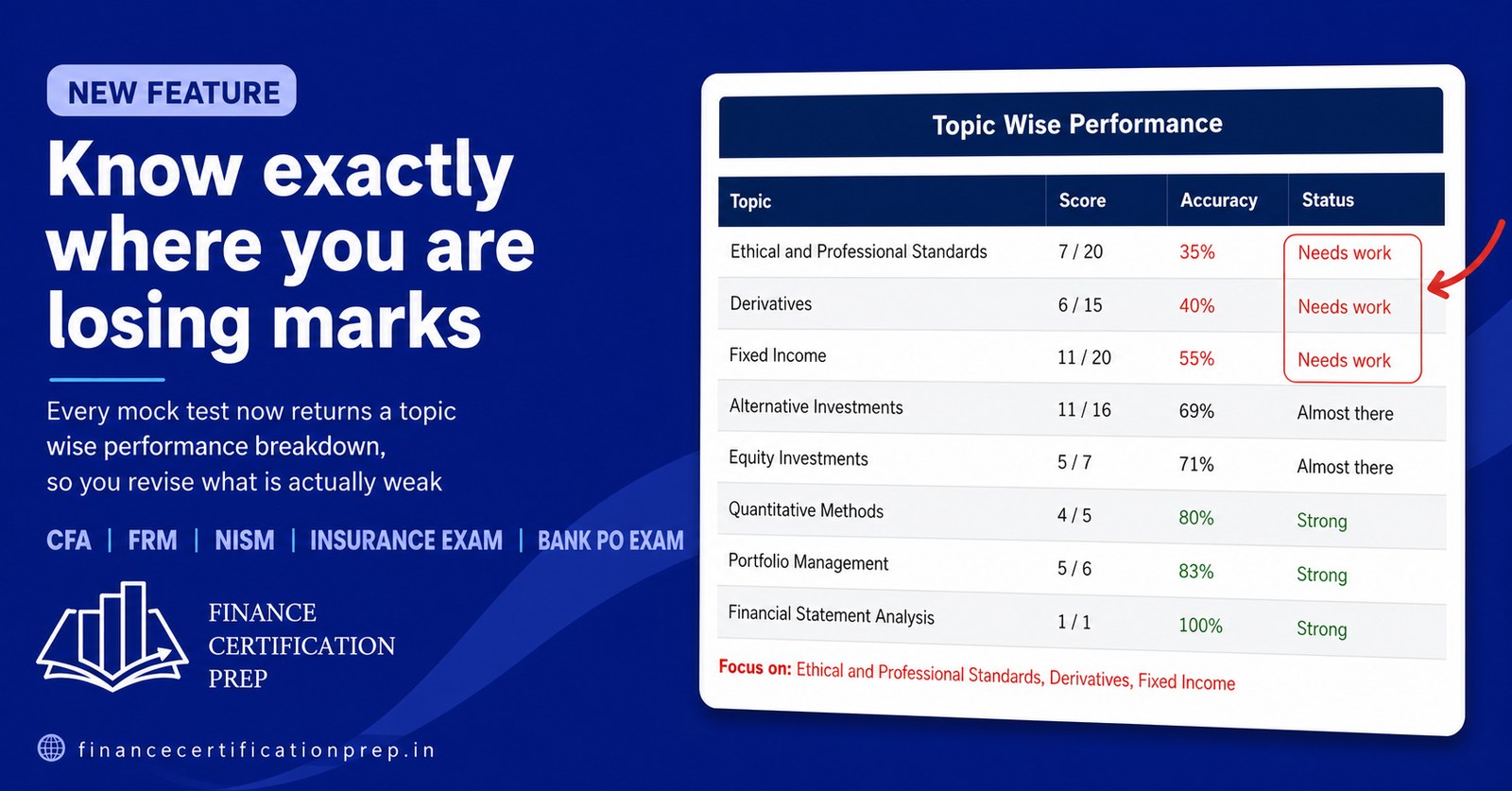
The full report card. Note the chapter table at the bottom: ranked by marks lost, not by percentage, and it reconciles exactly to the score.
How the clock actually works
Worth being precise, because a chart is only as honest as the number behind it.
The clock starts when a question appears and stops the moment you leave it. Come back later and it starts again, and the visits are added together, so a question you returned to three times shows the whole of what it took from you.
Switch away from the browser tab and it pauses. Time away from the page is tracked separately and never charged to any chapter. A phone call in the middle of your mock will never be recorded as difficulty.
And one point of honesty about that horizontal line. Until enough people have sat a given paper, it sits at the pace the paper itself allows, and it is labelled “expected pace” rather than “average”, because calling something an average when we do not have one would be a lie told with a straight face. Once a paper has enough attempts behind it, it switches to the real figure and relabels itself. You can always see which one you are being measured against.
Six weeks from now
You will sit the real paper, and you will have spent roughly forty evenings getting there.
The difference between passing and sitting it again is rarely the number of evenings. It is almost always which chapters got them.
Set 1 is free on every paper we publish. CFA Level 1 and Level 2, FRM Part 1 and Part 2, all 23 NISM modules, Insurance IC 38 and Bank PO. No card, no trial period.
Sit one. End it. Look at where your chapters land.
If derivatives turns out to be sitting in the bottom right quadrant, solid and fast and finished with, then tonight is the last night you spend on it.
Current Issues carries only 10 percent of the FRM Part 2 exam. It is also, year after year, the section candidates leave until last and study from outdated notes.
That is a mistake in any year. In 2026 it is an expensive one, because the reading list has rotated substantially and because the readings themselves are short, non quantitative and unusually easy to score on.
Here is the official 2026 list, taken from GARP’s Required Readings page, followed by what it signals and how to study it.
The official 2026 FRM Current Issues readings
Artificial intelligence
Two readings, which is worth pausing on.
IMF, Advances in Artificial Intelligence: Implications for Capital Markets Activities, Global Financial Stability Report, October 2024
Financial Stability Board, The Financial Stability Implications of Artificial Intelligence, November 2024
Private credit
Bank for International Settlements, The Global Drivers of Private Credit, February 2025
Geopolitical risk
IMF, Global Financial Stability Report, April 2025, Chapter 2
Risk of rising government debt
BIS Annual Economic Report, Section 2, Monetary and fiscal policy: safeguarding stability and trust
Cryptocurrency and digital assets
Also two readings.
IMF, Regulating the Crypto Ecosystem: The Case of Unbacked Crypto Assets
IMF Fintech Note, Tokenization and Financial Market Inefficiencies, January 2025
Digital resilience
Digital Resilience and Financial Stability: The Quest for Policy Tools in the Financial Sector
What is missing from that list is the real story
Read the list again and notice what is not on it.
There is no reading on traditional credit underwriting. Nothing on classic market risk measurement. No bank capital adequacy. No deposit franchise management.
Current Issues is the section GARP uses to test emerging themes before deciding whether they become permanent syllabus. It is, in effect, GARP’s public statement about where risk management is heading. And for 2026 that statement is almost entirely about technology, private markets, sovereign balance sheets and geopolitics.
Two readings on AI is a deliberate signal
GARP did not give artificial intelligence one reading. It gave it two, sourced from the IMF and the Financial Stability Board, which are the two bodies whose job is to worry about systemic risk.
The message is that AI model governance is no longer a specialist role sitting off to one side of the risk function. It is core examinable knowledge for anyone certifying as a risk professional. If you have been treating AI as somebody else’s problem, the syllabus has now disagreed with you in writing.
Private credit and tokenization sit alongside it
The other theme running through the list is assets that are large, growing quickly, and priced without a liquid observable market. Private credit. Tokenized instruments. Unbacked crypto assets.
Put the two themes together and you get a fairly precise description of the risk manager GARP wants to certify. Someone who can challenge a machine learning model in a governance forum, then turn around and value an exposure that has no market price. Those responsibilities used to sit in different departments.
If you are taking the FRM as a career move rather than as a certificate, that is the most useful thing on this page.
FRM Part 2 exam weights for 2026
The subject weights are unchanged.
Subject
Weight
Market Risk Measurement and Management
20%
Credit Risk Measurement and Management
20%
Operational Risk and Resilience
20%
Liquidity and Treasury Risk Measurement and Management
15%
Risk Management and Investment Management
15%
Current Issues in Financial Markets
10%
So keep your time split across subjects as it was. What changes is what you study inside Current Issues.
How to actually study Current Issues
Build fresh notes every year, without exception. This is the one section where reusing last year’s material is close to worthless. The list rotates annually by design.
Read the primary sources. These are IMF, BIS and FSB publications, not textbook chapters. They are readable, they are free, and GARP links to every one of them from its Required Readings page. Most candidates read a summary of a summary and lose the specific detail the questions are built on.
Study it early, then revisit twice. Current Issues rewards recency, so a common approach is to leave it to the end. The better approach is to read it early so the concepts connect to the rest of the syllabus, then do two short revision passes.
Expect qualitative questions. There is very little maths here. Questions test whether you understood the argument, the transmission channel, and the policy concern. That is why it is high scoring per hour, and why skipping it is such a poor trade.
Test whether your preparation is current
The fastest way to find out whether you are studying the right material is to sit a practice set built to the 2026 list.
Our FRM Part 2 question bank covers all six topics, with 10 sets per topic and 4,400 questions in total. Set 1 of every topic is free, with no payment required.
Start with the free Current Issues practice set. If you score above 70 percent, your preparation is current. If you do not, you have identified your gap while there is still time to close it.
You may also want to check the free Investment Management set, since private credit and private markets appear across both sections, and the free Market Risk set to confirm your quantitative work is holding up.
Frequently asked questions
What are the FRM Part 2 Current Issues topics for 2026?
Artificial intelligence with two readings from the IMF and the Financial Stability Board, private credit from the BIS, geopolitical risk from the IMF Global Financial Stability Report, the risk of rising government debt from the BIS Annual Economic Report, cryptocurrency and digital assets with two IMF readings including tokenization, and digital resilience.
How much is Current Issues worth in FRM Part 2?
Ten percent of the exam. With 80 questions on the paper, that is roughly 8 questions.
Can I reuse last year’s Current Issues notes?
No. The reading list is refreshed annually and 2026 has rotated substantially. Build fresh notes from the current official list each year.
Is Current Issues worth studying properly if it is only 10 percent?
Yes. The readings are short and qualitative, which makes them among the highest scoring sections per hour of study on the entire paper. It is usually a better use of a spare weekend than another pass through material you already know.
Where can I find the official FRM readings?
GARP publishes the required readings, with direct links to each source document, on its Required Readings page at garp.org.
Always confirm the exact reading list and learning objectives on garp.org before finalising your study plan. Reading list details in this article reflect GARP’s published Required Readings page at the time of writing. GARP does not endorse, promote, review or warrant the accuracy of the products or services offered by Finance Certification Prep.
The FRM November 2026 exam is exactly 12 weeks away. Part 1 runs November 14-20. Part 2 runs November 21-25. Standard registration closes September 30 at $800 per part. No late registration after that — the window closes entirely.
If you have not registered yet, you have 38 days. If you have registered, here is your week-by-week study plan.
Part 1: 100 Questions, 4 Hours, 4 Topics
Foundations of Risk Management: 20%
Quantitative Analysis: 20%
Financial Markets and Products: 30% — highest weight
Valuation and Risk Models: 30% — highest weight
Pass rate: 47% (November 2025). Roughly half of all candidates fail.
12-Week Part 1 Plan
Weeks 1-4 (Aug 23 — Sep 19): Financial Markets and Products (30%) and Valuation and Risk Models (30%). Together these are 60% of the exam. 2 weeks each. 80+ practice questions per topic. Focus on derivatives, bonds, options, hedging, and VaR models.
Week 6 (Sep 27 — Oct 3): Quantitative Analysis (20%). Probability, statistics, regression, hypothesis testing, VaR models. 60+ practice questions. Register by September 30 if not done — this is your last week.
Week 7 (Oct 4 — Oct 10): First full mock exam. Score topic by topic. Identify your two weakest areas.
Weeks 8-9 (Oct 11 — Oct 24): Targeted review of your two weakest topics. 100+ practice questions each. Build an error log. Start your second mock by end of week 9.
Week 10 (Oct 25 — Oct 31): Second full mock. Compare with mock 1 scores. Track improvement per topic. Review error log.
Week 11 (Nov 1 — Nov 7): Third full mock. Final error log review. Stop reading new material. Focus only on weak areas.
Week 12 (Nov 8 — Nov 13): Light review. Error log only. 1-2 practice sets per day. Rest the last 2 days before your exam window opens.
Part 2: 80 Questions, 4 Hours, 6 Topics
Market Risk Measurement: 20%
Credit Risk Measurement: 20%
Operational Risk and Resilience: 20%
Liquidity and Treasury Risk: 15%
Risk Management and Investment Management: 15%
Current Issues in Financial Markets: 10%
Pass rate: 50% (November 2025).
12-Week Part 2 Plan
Weeks 1-3 (Aug 23 — Sep 12): Market Risk (20%) and Credit Risk (20%). 40% of the exam combined. VaR, stress testing, credit scoring, counterparty risk. 80+ questions per topic.
Week 6 (Sep 27 — Oct 3): Liquidity and Treasury Risk (15%). Register by September 30 if not done. 50+ practice questions.
Week 7 (Oct 4 — Oct 10): Risk Management and Investment Management (15%). Portfolio risk, hedge fund strategies, private markets. 50+ practice questions.
Week 8 (Oct 11 — Oct 17): First full mock. Score topic by topic.
Week 9 (Oct 18 — Oct 24): Current Issues (10%). Read GARP’s published material twice. This is the easiest 10% if you read the material — and the hardest if you don’t. Start second mock.
Week 10 (Oct 25 — Oct 31): Second full mock. Error log. Weak-area review.
Week 11 (Nov 1 — Nov 7): Third full mock. Final error log review.
Take at least 3 full mocks. Candidates who take 3+ mocks pass at a significantly higher rate.
Study by topic weight. Financial Markets and Products is 30% of Part 1. Market and Credit Risk are 40% of Part 2. Do not spend equal time on every topic.
Register before September 30. After that, the window is closed. No late registration. No exceptions.
Register now. Start studying today. Take 3 mocks. Pass.
The CFA Institute is rolling out the biggest curriculum update in years for February 2027. Level 1 sees the most changes — 102 learning modules (up from 93), a new AI reading, expanded equities, restructured ethics, and more application-focused content throughout.
If you are deciding between November 2026 and February 2027, this matters. Here is what changed, what stayed the same, and how to prepare.
What Changed in Level 1
1. New AI & Financial Data Science Reading — A brand new module in Quantitative Methods covering AI concepts, machine learning applications in finance, and data science fundamentals. This is the CFA Institute’s response to the industry shift toward AI-driven investment analysis.
2. Equities Expanded from 8 to 12 Modules — Equities has been overhauled. New modules cover DCF and growth models, relative valuation, equity research reports, and factor-based investing. Learning outcomes reduced from 66 to 37 — less breadth, more depth. The focus is on practical application: building models, writing research, and understanding factor exposure.
3. Ethics Restructured — The 7 Ethics Standards are now split into individual learning modules, each with updated content. Ethics weight remains 15-20% — the highest individual topic weight. The restructuring makes each standard easier to study in isolation and test independently.
4. Quantitative Methods Reorganized — Quant Methods has been restructured around real-world applications. The new AI reading lives here. Statistics and regression content is more streamlined. Topic weight: 6-9% (unchanged).
5. 102 Learning Modules Total (up from 93) — The increase is driven by the Ethics split (7 standards to 7 modules), Equities expansion (8 to 12 modules), and the new AI reading. The total page count is roughly similar — the curriculum is reorganized, not significantly longer.
Exam format: 180 multiple-choice questions, two 2-hour-15-minute sessions, computer-based.
Passing score: 70%+ recommended across all topics.
Level 2 and Level 3 Changes
Level 2: Mostly stable. Minor updates in Ethics to match Level 1 restructuring. Topic weights unchanged. No new readings. If you are taking Level 2 in 2027, your 2026 study materials are still largely valid — but update your Ethics content.
Level 3: Minor Ethics update only. Core topics and specialized pathways (Portfolio Management, Private Wealth, Private Markets) are unchanged.
Practical Skills Modules — Now Mandatory
Every level now requires completion of Practical Skills Modules (PSMs) — 10-20 hours per level. These are separate from the exam but mandatory for receiving your result.
Level 2 PSM options: Analyst Skills, Macro Insights, or Portfolio Construction
Level 3 PSM: Portfolio Development and Construction
Choose your PSM topic after registration. You can begin anytime. Complete it before your exam date — your result is withheld until the PSM is done.
How to Prepare for 2027
If taking November 2026: Use 2026 materials. No curriculum changes apply. Register before standard deadlines close.
If taking February 2027: Wait for updated 2027 materials. Do not study from 2026 content for Ethics, Equities, or Quant — the restructuring means different readings, different modules, and different learning outcomes.
Start your PSM early: Pick your PSM topic immediately after registration. Complete it in the first 4-6 weeks — do not leave it for the last month.
Focus on application: The 2027 curriculum is more application-focused. Memorization of formulas is less useful than understanding how to apply concepts to scenarios.
Update your Ethics: Ethics is the highest-weighted topic at every level. The 2027 restructure changes how standards are tested. Use 2027 Ethics materials specifically.
The Bottom Line
The 2027 curriculum update makes the CFA more practical, more AI-relevant, and more application-focused. Level 1 candidates feel the changes most. Level 2 and 3 candidates see minimal updates.
If you want the current curriculum, take November 2026. If you want the updated, AI-inclusive curriculum, take February 2027 or later.
If you are in finance in India, you have probably asked: CFA or FRM? The answer depends on what you want to do — but the question is worth asking carefully, because the cost, time, and career path for each are very different.
The Basics
CFA Charter (CFA Institute):
3 levels (Level 1, 2, 3) — sequential, must pass each to move to the next
~300 hours of study per level (900+ total)
Total cost: $3,520-4,600 (enrollment + all 3 exams at standard rates)
2 parts (Part 1, Part 2) — can take both in the same day if confident
~150-300 hours per part (300-600 total)
Total cost: $1,200-1,600 (enrollment + both parts at standard rates)
Time to complete: 1-2 years (most take 1.5)
Pass rates: Part 1 ~47%, Part 2 ~50% (November 2025)
The FRM is faster and cheaper. The CFA is broader and carries more weight in traditional finance roles.
What Each Covers
CFA — Broad finance: Ethics and professional standards, financial statement analysis, equity valuation and investment, fixed income and derivatives, portfolio management, economics and quantitative methods, alternative investments, wealth planning (Level 3).
FRM — Specialized risk: Risk foundations and frameworks, quantitative analysis (statistics, regression, VaR), financial markets and products (derivatives, banking, insurance), valuation and risk models (Part 1), market/credit/operational risk (Part 2), liquidity and treasury management, investment management and risk, current issues in risk (Part 2).
The CFA teaches you to analyze and manage investments. The FRM teaches you to identify, measure, and manage risk. They are complementary — not substitutes.
India Salary Comparison
CFA Charterholders in India:
Entry-level (0-3 years): ₹6-12 LPA
Mid-career (4-9 years): ₹15-30 LPA
Senior (10+ years): ₹25-50+ LPA
Top roles: Portfolio manager, equity research, investment banking — ₹40-80+ LPA at top firms
FRM Holders in India:
Entry-level (0-3 years): ₹6-10 LPA
Mid-career (3-5 years): ₹12-22 LPA
Senior (5+ years): ₹18-35 LPA
Top roles: Chief Risk Officer, head of risk at banks/NBFCs — ₹35-60+ LPA at top firms
The CFA has a higher salary ceiling, especially in portfolio management and investment banking. The FRM delivers faster ROI — lower cost, shorter time, and strong demand in risk roles at banks, NBFCs, and global capability centers (GCCs).
Which Roles Prefer Which
Choose CFA if you want:
Investment banking (M&A, capital markets)
Portfolio management (asset management, PMS)
Equity research (sell-side or buy-side)
Wealth management and financial advisory
Corporate finance and strategy
Choose FRM if you want:
Risk management (credit, market, operational)
Banking compliance and Basel III/IV
Treasury and liquidity management
Risk consulting (Big 4, specialized firms)
Quantitative and model validation roles
Can You Do Both?
Yes — and many finance professionals in India do. The CFA gives you investment expertise. The FRM gives you risk expertise. Together, they make you a rare candidate who understands both sides of the balance sheet.
Recommended path: Start with the one that aligns with your current role. If you are in investment analysis or portfolio management, start with CFA. If you are in risk, compliance, or treasury, start with FRM. Complete one before starting the other — splitting focus across both simultaneously is how candidates fail both.
Cost vs ROI
CFA: $3,520-4,600 + 900+ hours. Higher salary ceiling. Longer time to payoff.
FRM: $1,200-1,600 + 300-600 hours. Faster completion. Strong ROI in risk roles.
If you are early in your career and unsure which path to take, the FRM is the lower-risk bet — less money, less time, and strong demand. If you are committed to investment management or banking, the CFA is the gold standard.
The FRM November 2026 exam is 12 weeks away. Standard registration closes September 30 — 41 days from today. The fee is $800 per part. After September 30, there is no late registration. The window closes entirely.
If you have not registered yet, this is your last chance to secure your spot at standard fees. If you have already registered, this is your 10-week study plan.
Weeks 1-4 (Aug 20 — Sep 16): Cover Financial Markets and Products (30%) and Valuation and Risk Models (30%) first. Together 60% of the exam. 2 weeks on each. 80+ practice questions per topic.
Weeks 5-7 (Sep 17 — Oct 7): Cover Foundations (20%) and Quantitative Analysis (20%). More conceptual. 7 days each. 60+ practice questions per topic.
Week 8 (Oct 8 — Oct 14): First full mock exam. Score topic by topic. Register before September 30 if you have not already — this is your last week.
Weeks 9-10 (Oct 15 — Oct 28): Two more full mocks. Build an error log. Focus on your two weakest topics. Stop reading new material by October 20.
Weeks 11-12 (Oct 29 — Nov 13): Final review. Error log only. 2-3 practice sets per day. Rest the last 2 days.
Waiting to register: After September 30, the window is closed. No late registration. Register now or miss this cycle entirely.
Skipping mocks: Candidates who take 3+ full mocks have a significantly higher pass rate.
Ignoring topic weights: Financial Markets and Products is 30% of Part 1. Market and Credit Risk are 40% of Part 2. Prioritize by weight.
Memorizing formulas without application: GARP tests whether you can apply a formula to a scenario, not recite it.
Leaving Current Issues for the last 3 days: Part 2 Current Issues is 10% for low effort — but only if you read the material twice. Cramming does not work.
Register before September 30. Start studying today. Take at least 3 mocks. Pass.
NISM exams do not work the way most Indian certification exams work, and this catches people out constantly. If you are searching for a NISM exam date expecting a fixed calendar day, there is not one. NISM certification examinations run on a rolling basis at test centres across India, and the registration window stays open all year. The date of your exam is whichever slot you book.
The confusion is made worse by the numbering. NISM refers to its exams by Roman numeral series numbers, and almost nobody searching remembers which numeral maps to which subject. This guide covers the mapping, what changed for Research Analyst candidates in 2026, and how booking actually works.
What each NISM series number means
These are the series most candidates are searching for, with the subject each one actually covers.
Series
What it covers
Who needs it
Series V A
Mutual Fund Distributors
Anyone selling or distributing mutual funds. The highest volume NISM exam by a wide margin.
Series VI
Depository Operations
Staff of depository participants handling demat accounts.
Series VIII
Equity Derivatives
Staff of trading members dealing in equity derivatives.
Series IX
Merchant Banking
Professionals working on issue management and corporate advisory.
Series X A and X B
Investment Adviser Level 1 and Level 2
Required to register as a SEBI Investment Adviser.
Series XII
Securities Markets Foundation
Newcomers wanting a recognised grounding before specialising.
Series XIII
Common Derivatives
Combines equity, currency and interest rate derivatives in one exam.
Series XV
Research Analyst
Required to register as a SEBI Research Analyst. This is the one people mean when they search NISM 15.
Series XVII
Retirement Adviser
Those advising on retirement and pension products.
Series XIX C, D and E
Alternative Investment Fund Managers
Managers of AIFs, split by fund category.
Series XXI A
Portfolio Management Services Distributors
Mandatory for anyone distributing PMS for a portfolio manager.
What changed for NISM Series XV in 2026
If you are preparing for the Research Analyst exam, this is the most important section on this page, and it is the reason a lot of older study material is now misleading.
A revised NISM Series XV Research Analyst Certification Examination took effect from 20 January 2026. The previous version of the examination content was available only up to 19 January 2026. Anyone booking a slot from 20 January 2026 onwards sits the revised paper.
Three things changed in substance.
The format now includes case based questions. The revised paper is structured as 80 standalone multiple choice questions plus 5 case sets carrying 4 questions each, so case based material accounts for roughly 20 percent of the paper. This is a meaningful shift. Standalone recall questions reward memorisation, while case sets require you to read a scenario and apply judgement across several linked questions.
New content was added. Dedicated Technical Analysis content carrying 15 marks and Fundamental Analysis of Commodities carrying 5 marks now appear in the syllabus. Twenty marks of a hundred mark paper is a large allocation to material that was not previously examined in this form.
The eligibility rules changed underneath it. The revision aligns the certification with the SEBI Research Analysts Amendment Regulations 2025. SEBI removed the strict requirement to hold a specific finance or commerce degree. If your background is in arts, engineering or law, the NISM Series XV certificate is now your main route to demonstrating domain knowledge rather than a supplementary credential.
The practical implication is simple. If you bought or downloaded study material before January 2026, it does not cover technical analysis or commodities, and it does not prepare you for case sets. Practising against outdated questions is the most common avoidable reason candidates fail this paper.
How NISM exam booking actually works
The process is straightforward but has a few steps that catch people out on timing.
First, create an account on the NISM online certification portal and complete your profile. You will need a scanned PAN card, a passport sized photograph and your Aadhaar details for KYC verification. NISM typically takes 24 to 72 hours to verify and approve your profile, so this is not something to do the night before you want to book.
Once approved, enrol for your chosen exam, then select a test centre and time slot from what is available. NISM has centres in most major Indian cities. Check seat availability before you commit, because popular centres in Mumbai, Delhi, Bengaluru and Hyderabad book out further ahead than smaller cities, and this is the real constraint on how soon you can sit.
You then pay the registration fee, with UPI, credit card, debit card and net banking all accepted. Your admit card becomes available in your account within 24 hours of booking, under My Enrollments and then Upcoming Exams. Print it and carry it with a valid photo ID on the day.
Most NISM certifications are valid for three years from the date you pass, after which you renew through a Continuing Professional Education programme rather than by sitting the full exam again.
Always confirm current fees, the syllabus version and slot availability on the official NISM website before you book. Syllabus revisions like the Series XV change above are announced there first.
How to prepare once you have picked your series
Read the official NISM workbook for your series once, properly, then switch to practice questions as early as you can stand to. NISM exams reward pattern recognition more than depth. Questions are drawn tightly from the workbook, they repeat structural patterns across attempts, and the difference between a 55 and a 65 is almost always familiarity with how questions are phrased rather than extra reading.
Negative marking, where it applies, should change your strategy. On Series XXI A a wrong answer costs 10 percent of the mark, so a genuine guess between four options is roughly break even, and a guess after eliminating two is clearly worth taking. Know your series rules before you walk in.
Set 1 of every series below is free, runs on the real exam pattern, and returns a unit wise report card so you can see which chapters still need another pass before you book a slot.
No. NISM certification examinations run on a rolling basis at test centres across India and the registration window is open all year. Your exam date is whichever available slot you book, so the real constraint is seat availability at your preferred centre rather than any national exam calendar.
What is the NISM 15 exam?
NISM Series XV is the Research Analyst Certification Examination, required to register as a SEBI Research Analyst. A revised version of this examination took effect from 20 January 2026.
What changed in NISM Series XV in 2026?
The revised exam introduced case based questions worth 20 percent of the paper, structured as 80 standalone multiple choice questions plus 5 case sets of 4 questions each. Dedicated Technical Analysis content carrying 15 marks and Fundamental Analysis of Commodities carrying 5 marks were added. The revision aligns the certification with the SEBI Research Analysts Amendment Regulations 2025.
Do I need a finance degree to become a Research Analyst?
Not any more. SEBI removed the strict requirement for a specific finance or commerce degree, which means candidates from arts, engineering or law backgrounds can qualify. The NISM Series XV certification is now the primary way to demonstrate domain knowledge.
How long does NISM take to approve my registration?
NISM typically takes 24 to 72 hours to verify your profile documents. Once approved you can enrol for an exam, choose a centre and slot, and pay. Your admit card is available in your account within 24 hours of booking.
How long is a NISM certification valid?
Most NISM certifications are valid for three years from the date you pass. Renewal is through a Continuing Professional Education programme rather than by sitting the full examination again.
What is the pass mark for NISM exams?
It varies by series. NISM Series XXI A for PMS distributors requires 60 percent with 10 percent negative marking. Check the official workbook for your specific series, because both the pass mark and the negative marking rule differ between them.
Starting February 2027, the CFA Institute is eliminating the paid deferral option. This is the biggest policy change to the CFA exam in years — and it directly affects how you plan your registration.
What Changes in 2027
Currently, if you cannot take your scheduled exam, you can pay $449 to defer to a future exam window. You keep your registration — you just move it forward.
From February 2027 onward, this option is gone. If you register and do not show up:
Your registration fee ($1,140 or $1,490) is forfeited
You cannot carry it forward to another window
You must register and pay again for the next available window
In effect, missing the exam means losing $1,140-1,490 and starting over.
What Stays the Same
Rescheduling within the same exam window: You can still change your test date or location within your registered window for a $250 fee. This is not a deferral — it is a reschedule.
Emergency deferrals: Still available, but tighter. Qualifying reasons:
Life-threatening illness (yourself or immediate family)
Mandatory military deployment
Death in the immediate family
Prometric test center closure on your exam day
Emergency deferrals cost $100 (processing fee) and require documentation. If approved, you get 12 months to use the deferred registration.
What No Longer Qualifies
Pregnancy — unless life-threatening complications. Previously a qualifying reason, now excluded.
Work commitments — never qualified, but candidates often assumed “busy season” was a valid reason. It is not.
General stress or unpreparedness — not a qualifying emergency. The CFA Institute expects you to assess your readiness before registering.
Why This Matters Now
Registration for the February 2027 Level 1 and Level 3 window is open right now — standard registration closes November 5, 2026. Registration for the May 2027 Level 1 and Level 2 window opened August 12, 2026.
If you register for either window, you are committing to take the exam. No $449 safety net. No paid deferral backup.
The Readiness Checklist Before You Register
Before you pay $1,140-1,490, ask yourself:
Can I commit 250-300 hours over the next 6-9 months? If not, do not register yet.
Do I have a stable study schedule? 8-12 hours per week is the minimum for a 6-month plan.
Is my exam window free of major life events? If you have a wedding, relocation, or busy season planned, choose a different window.
Do I have a backup plan for emergencies? Save the emergency deferral documentation requirements. If you get sick, get medical documentation immediately.
Have I taken a diagnostic mock exam? If you score below 50%, you need more prep time before committing $1,490.
The New Cost of Not Being Ready
In 2026: Register ($1,490) → realize you are not ready → defer ($449) → take exam later. Total cost: $1,939.
In 2027: Register ($1,490) → realize you are not ready → forfeit registration → register again ($1,490). Total cost: $2,980.
That is a $1,041 difference. The new policy makes preparation more important than ever.
The Bottom Line
The CFA Institute is telling candidates: be ready before you register. The paid deferral was a safety net — it is gone. Emergency deferrals cover genuine crises only. Rescheduling within the same window still works for $250.
Assess your readiness honestly. Pick the right window. Study consistently. Show up on exam day.
Registration for the CFA Level 2 May 2027 exam opened on August 12 — one week ago. The exam runs May 18-22, 2027. Early registration is $1,140. Standard registration is $1,490. You have 9 months to prepare.
That is the ideal prep window. Level 2 is widely considered the hardest of the three CFA exams — not because the content is more complex, but because the format demands deeper analysis under time pressure.
Level 2 pass rate: 43% (May 2026). Historical average: 45-46%. May 2026 was below the all-time average.
More than half of candidates fail. Here is how to be in the passing half.
Register now: Early registration ($1,140) saves you $350 vs. standard ($1,490).
Level 1 tests breadth — 180 standalone questions across 10 topics. Level 2 tests depth. The exam has 22 item sets (vignettes), each a mini case study with 4 multiple-choice questions. 88 questions total.
You get roughly 3 minutes per question — but you also need 2-3 minutes to read the vignette before answering. Time management is the single biggest challenge.
2027 curriculum updates: Corporate Issuers is now Corporate Finance. Equity Valuation is now Equities. Topic weights remain 5-15% for all topics — but the heaviest topics carry 10-15% each.
Topic Weights and Priority
The heaviest five — Ethics, FSA, Equities, Fixed Income, Portfolio Management — can account for 50-75% of the exam. Master these five first.
Ethics (10-15%): Mandatory pass. If you fail Ethics, you fail the exam.
Ethics: Read the CFA Institute Ethics Code twice. Do every practice question available. Ethics is a must-pass — failing Ethics means failing the exam regardless of your other scores.
Cover Corporate Finance, Derivatives, Alternative Investments, Quantitative Methods, and Economics. Each is 5-10% — lower weight but still 25-50% of the exam combined.
Move through quickly — 3-4 days per topic. 30+ practice questions per topic. Take your first full mock exam at the end of February.
Phase 4: Mock Exams and Review (March-April, ~60 hours)
Take 3-4 full mock exams under exam conditions — 22 item sets in 4 hours 12 minutes (two 2-hour 6-minute sessions with an optional break).
Build an error log. For every wrong answer, note: the topic, the concept, why you got it wrong, and what you will do differently.
Focus remaining time on your three weakest topics. Stop reading new material by April 15.
Phase 5: Final Review (May, ~20 hours)
Review your error log. Practice 2-3 item sets per day. Light, focused work. Do not cram. Do not take new mocks in the last 3 days — rest your mind.
Item Set Strategy: How to Beat the Vignette Format
Read the questions first: Before reading the vignette, scan the 4 questions. This tells you what information to look for.
Time yourself: Allocate 12 minutes per item set — 3 minutes to read, 9 minutes for 4 questions. If you exceed 15 minutes, flag and move.
Mark answers on the vignette: Underline key numbers, dates, and ratios as you read. You will not have time to re-read.
Watch for traps: Level 2 questions often include irrelevant information in the vignette to test whether you can identify what matters.
Do not leave blanks: There is no negative marking. If you are stuck, eliminate 2 options and guess between the remaining 2.
Register Now. Start Today. Pass in May.
9 months at 8-10 hours per week is 320-360 hours — well above the 300-hour benchmark. The candidates who pass start early, study consistently, and arrive with 4+ full mocks behind them.
Register before the early deadline to save $350. Pick your exam slot immediately after registering — test centers fill up fast in major cities.
The FRM November 2026 exam is your next opportunity to advance your risk management career. Part 1 runs November 14-20. Part 2 runs November 21-25. Standard registration closes September 30, 2026 — 6 weeks from today. The fee is $800. After September 30, you cannot register for this window.
If you have not registered yet, this post is your action plan. If you have already registered, this is your revision roadmap.
Weeks 1-3 (Aug 17 — Sep 6): Cover Financial Markets and Products (30%) and Valuation and Risk Models (30%) first. Together 60% of the exam. 10 days on each. 80+ practice questions per topic.
Weeks 4-5 (Sep 7 — Sep 20): Cover Foundations (20%) and Quantitative Analysis (20%). More conceptual. 7 days each. 60+ practice questions per topic.
Week 6 (Sep 21 — Sep 30): First full mock exam. Score topic by topic. Register before September 30.
Post-Registration (Oct 1 — Nov 13): Two more full mocks. Build an error log. Focus on weak topics. Stop reading new material by November 1.
The CFA February 2027 exam window offers both Level 1 (Feb 22-28) and Level 3 (Feb 18-21). Registration is open now — standard registration closes November 5, 2026. That is 11 weeks from today. After that, you cannot register for this window.
If you have not started studying, now is the time. Six months of structured prep is the sweet spot for both levels.
Level 1 pass rate: 41% average. Feb 2026 was 45%, May 2026 dropped to 39%. Level 3 pass rate: 50% average. Feb 2026 was 50%.
The candidates who pass start early, study consistently, and arrive with 300+ hours behind them.
Register now: Standard registration ($1,490) closes November 5, 2026.
Phase 1 (Aug-Oct): Quant (6-9%), Economics (6-9%), FSA (11-14%). Master FSA early — it is where most candidates lose points. 150 hours.
Phase 2 (Nov-Dec): Equity (11-14%), Fixed Income (11-14%), Corporate Issuers (6-9%), Portfolio Management (8-12%). These four topics are 36-49% of the exam. 110 hours.
Phase 3 (Jan): Ethics (15-20%), Derivatives (5-8%), Alternative Investments (7-10%). Ethics is the highest single-topic weight — treat it as core. 55 hours.
Phase 4 (Feb): 4-6 full mock exams. Score topic by topic. Build an error log. Stop reading new material. 45 hours.
Level 3 includes constructed response (essay) questions alongside item sets. It tests application, not recall. You must choose a specialized pathway (Portfolio Management, Private Wealth, or Private Markets) worth 30-35% of the exam.
Phase 1 (Aug-Oct): Asset Allocation (15-20%) and Portfolio Construction (15-20%). Together 30-40% of the exam. Master capital market expectations and portfolio optimization. 130 hours.
Phase 3 (Jan): Your specialized pathway (30-35%). Choose early — do not switch after January. Practice constructed response answers. 60 hours.
Phase 4 (Feb): 3-4 full mocks including essay sections. Practice writing under time pressure. The essay format is where most Level 3 candidates lose marks. 50 hours.
If you register before November 5, you pay $1,490. If you miss it, the next Level 1 window is May 2027 and the next Level 3 window is August 2027 — a 3-6 month delay in your CFA journey.
Register now, pick your exam slot by November 10, and start studying today. Six months at 12-13 hours per week is sustainable. Three months at 25 hours per week is not.
The FRM Part 2 November 2026 exam runs November 21-25. Standard registration is open now at $800 through September 30. That gives you roughly 90 days from today — enough time to prepare if you follow a structured plan.
The FRM Part 2 pass rate hovers around 50-55%. November 2025 saw 50%. The 10-year average is 55-58%. This is not an exam you can pass by cramming. But it is very passable with 90 days of focused, topic-prioritized study.
The exam: 80 multiple-choice questions, 4 hours, 6 topics. Here is how to conquer each one.
Register now: Standard registration ($800) closes September 30, 2026.
Liquidity & Treasury Risk (15%): Liquidity gaps, funding risk, intraday liquidity, ALM. Moderate difficulty, high overlap with Market Risk.
Risk Management & Investment Management (15%): Portfolio risk, factor models, risk budgeting, hedge fund strategies. Builds on Part 1 quant concepts.
Current Issues (10%): GARP publishes reading material before the exam. Read it 2-3 times. Do not skip — it is 10% of your score for relatively low effort.
Your 90-Day Study Plan
Phase 1: Market and Credit Risk (Days 1-35, ~100 hours)
Start with Market Risk (20%) and Credit Risk (20%) — together that is 40% of the exam. These are calculation-heavy and build the quantitative foundation for the rest of the syllabus.
Spend 18 days on Market Risk. Master VaR methodologies (historical, parametric, Monte Carlo), EVT, backtesting, and stress testing. Do 100+ practice questions.
Spend 17 days on Credit Risk. Master PD models, credit spreads, CVA, counterparty credit risk, and Basel credit risk frameworks. Do 100+ practice questions.
Target: 100 hours. Readings, practice questions, and topic-wise mock tests for both topics.
Cover Operational Risk & Resilience (20%) and Liquidity & Treasury Risk (15%). Together 35% of the exam.
Operational Risk is more conceptual — focus on frameworks, Basel standards, governance, and resilience. Less formula-heavy but high on application questions.
Liquidity Risk overlaps with Market Risk concepts. Focus on liquidity gap analysis, funding risk, and intraday liquidity management.
Target: 70 hours. Readings, practice questions, and topic-wise mock tests.
Phase 3: Investment Management and Current Issues (Days 61-75, ~50 hours)
Cover Risk Management & Investment Management (15%) and Current Issues (10%).
Investment Management builds on Part 1 quant — portfolio risk, factor models, risk budgeting. If you remember Part 1 well, this goes faster.
Current Issues: GARP publishes specific reading material before each exam. Read it 2-3 times. Take notes. This is 10% of your score for the least study effort — do not leave it to the last week.
Target: 50 hours. Readings, practice questions, and Current Issues material.
The August 2026 CFA exam windows are here. Level I (Aug 18-24), Level II (Aug 25-29), Level III (Aug 11-15). Whether you are sitting this month or preparing for the next window, here is what to do in the final week — and what to stop doing — for each level.
Level I: Triage and Drill (180 MCQs, two sessions of 90)
Your final week is not about learning new material. It is about extracting maximum points from what you already know.
Take one full mock under exam conditions. Score it topic by topic. Build an error log: for every wrong answer, note the topic, why you got it wrong, and the correct concept.
Focus your remaining time on the High-ROI Four: Ethics (15-20%, the #1 tiebreaker for borderline scores), FSA (11-14%), Fixed Income (11-14%), and Equity (11-14%). These account for 48-62% of your score.
Stop rereading textbook chapters. Stop watching video lectures. Stop starting new topics. Every hour spent on passive review is an hour not spent diagnosing errors.
Level II: Vignette Mastery (88 questions, 22 item sets, two sessions of 11)
Level II does not test whether you remember a concept. It tests whether you can apply it inside a realistic investment scenario. That is why strong candidates do not just know the curriculum — they know how to work through vignettes efficiently.
Preview the questions first. Identify the topic, entities, calculations required, and key dates. Then read the vignette actively, searching for the information the questions demand. Do not read it as a story — read it as an investment case.
Separate entities: parent vs subsidiary, current-year vs forecast, domestic vs foreign currency. A surprising number of errors come from mixing up entities.
Manage time: 12 minutes per item set. If you are 15 minutes into a vignette and still stuck, flag it and move. Two item sets are unscored trial sets — do not waste your best energy on a question that does not count.
Level III: Constructed Response + Time Discipline (4 hours 24 minutes, two sessions)
Level III is the only CFA exam with constructed response (essay) questions. The first session has 8-11 vignettes with written responses. The second session has 11 item sets with multiple-choice.
For constructed response: write in bullet points, not paragraphs. Label each answer with the question number. Show your calculations. If you are unsure, write the framework and the key formula — partial credit is available.
Time is the real exam. Many candidates know the material but cannot finish. Practice with a timer: 90 seconds per multiple-choice question, 3-4 minutes per constructed response question. If you go over, flag and move.
Portfolio Management is the core of Level III (35-40% of the exam). If your PM is weak, your entire score is at risk. Drill PM in your final week.
Valid international passport (the only accepted ID). TI BA II Plus or HP 12C with fresh CR2032 battery and small screwdriver. Arrive 30 minutes early. No watches, phones, or calculators other than the approved models.
Do not study the night before. Your brain needs 24 hours of rest before 4+ hours of exam performance. Eat well, sleep 7-8 hours, set two alarms.
The FRM curriculum evolves every year, and 2026 brings the most significant update to Part 2 in years. GARP has added 7 new readings, revised key sections, and removed 11 outdated readings to align with today’s risk landscape — Basel III/IV reforms, AI in finance, climate risk, and private markets.
If you are preparing for the November 2026 FRM exam (Part 1: Nov 14-20, Part 2: Nov 21-25), here is what changed and exactly how to adjust your prep. Using 2025 study materials for Part 2 will leave significant gaps.
Part 1: Minimal Changes, But More Applied
Part 1 has no new topics and no removed topics. Topic weights are unchanged: Foundations of Risk Management (20%), Quantitative Analysis (20%), Financial Markets and Products (30%), Valuation and Risk Models (30%).
The only update is in Quantitative Analysis — Stationary Time Series (QA-10) has been revised with five reworded learning objectives. The shift is from conceptual memorization to applied interpretation and analytical reasoning.
What this means for your prep: If you have 2025 Part 1 materials, they are still largely usable. But practice questions for Quantitative Analysis must be 2026-updated — the new LOs test diagnostics and scenario reasoning, not formula recall.
Part 2: Major Overhaul — 7 New Readings, 11 Removed
Part 2 readings increased from 104 to 107. The changes are concentrated in three areas: Risk Management and Investment Management, Current Issues, and Liquidity Risk.
New Reading 1: Hedge Fund Investment Strategies, Risk, Regulation and Organizational Structure
Covers hedge fund strategies (long/short, event-driven, macro), risk management frameworks, and regulatory structures. Exam relevance: high — hedge fund risk is now explicitly tested.
New Reading 2: Private Markets Investing
Covers private equity, private credit, and venture capital risk. The global private credit market has grown to $1.7 trillion, making this a critical real-world risk topic. Exam relevance: high — private markets risk was not covered in previous curricula.
New Reading 3: Distress Symptoms and Remedies
Covers early warning signs of financial distress and remediation strategies. Exam relevance: medium — expect scenario-based questions on identifying and responding to distress signals.
New Reading 4: Madoff — A Riot of Red Flags
A case study on the largest Ponzi scheme in history, focusing on operational risk failures and red flag identification. Exam relevance: high — case study questions test applied operational risk knowledge.
New Reading 5: Market-Driven Scenarios — An Approach for Plausible Scenario Construction
Covers scenario generation methodology for stress testing. Exam relevance: high — scenario construction is now a core Part 2 skill.
New Reading 6: Illiquid Assets (reassigned)
Illiquid Assets has been moved from Liquidity Risk to Investment Management, reflecting the intersection of liquidity and portfolio risk.
New Reading 7: Current Issues Overhaul — 5 New Readings
Advances in Artificial Intelligence: Implications for Capital Markets Activities
The Financial Stability Implications of Artificial Intelligence
The Global Drivers of Private Credit
Tokenization and Financial Market Inefficiencies
Global Financial Stability Report (retained)
What this means for your prep: Part 2 requires 2026-updated materials. No exceptions. The new readings on AI, private credit, tokenization, and hedge fund strategies are not covered in any 2025 prep resource.
1. Part 1 candidates: Your study plan is stable. 2025 materials are fine for all topics except QA-10. Get 2026-updated practice questions for Quantitative Analysis only.
2. Part 2 candidates: Prioritize the new readings first. AI in finance, private markets, hedge fund strategies, and scenario construction are high-exam-relevance topics that old materials do not cover. Allocate 15-20% of study time to new readings.
3. Current Issues is now higher-stakes. With 5 new readings replacing 6 old ones, the content is entirely refreshed. AI, private credit, and tokenization dominate. Do not rely on 2025 Current Issues notes.
4. Practice on 2026-style questions. The 2026 exam is more analytical and scenario-driven. Focus practice on scenario generation, model validation, AI in finance, and hedge fund strategies.
The FRM remains one of the most in-demand risk management certifications globally. In India, FRM-certified professionals earn Rs 8-14 LPA at mid-level, Rs 18-35 LPA at senior level, and Rs 50+ LPA as Chief Risk Officers. Hiring is strongest in banking, fintech, consulting, and asset management — sectors where Basel III/IV compliance, AI risk modelling, and climate risk integration are now mandatory.
The exam window opens August 18. You have 7 days. Most candidates waste this week rereading notes they already know. The candidates who pass use this week differently — they triage ruthlessly, drill only high-ROI topics, and practice exam execution. Here is what to revise, what to skip, and how to extract maximum points.
What to Revise: The High-ROI Four
These four topics account for 48-62% of your exam score. If you only study these, you can still pass.
Ethics (15-20%)
The single highest-weight topic and the #1 tiebreaker for borderline scores. If you are at the Minimum Passing Score and your Ethics is above 70%, you get bumped up. If it is below 50%, you get bumped down. Do 100+ scenario-based questions on Standards I-VII. Read the CFA Institute Ethics text — it is the only reading worth doing in the final week.
Revenue recognition, lease accounting, financial ratios, cash flow classification. This is where calculation errors cost the most points. Do 60-80 targeted practice questions. Review every wrong answer in your error log.
Stop doing these immediately. Every hour spent here is an hour stolen from the High-ROI Four.
Rereading textbook chapters: The marginal value of a second read is near zero compared to practice questions.
Watching video lectures: A four-hour video costs you the entire afternoon and produces almost no exam-ready knowledge.
New topics you have not started: If you have not touched Derivatives or Alternative Investments by now, do not start. Bank that time for Ethics and FSA.
Highlighting and notetaking: Passive review feels productive. It is not.
Multiplier 1: The Error Log That Drives Everything
Take one full mock today (4.5 hours, exam conditions). Score it topic by topic. For every wrong answer, note: topic, why you got it wrong (concept gap, calculation error, misread question, time pressure), and the correct concept. This error log drives your entire week. You no longer study “what is next in the textbook” — you study what your last 50 questions told you to.
Take a second mock on Day 5. Compare. If a topic is still below 60% after two mocks, stop drilling it. Redirect time to topics where you are at 65%+ and can push to 75%.
The exam gives you 90 seconds per question. Your TI BA II Plus can save 10-15 seconds per calculation. Over 180 questions, that is 20+ minutes — the difference between finishing and rushing.
Use the CF worksheet for NPV/IRR. Use the Data worksheet for statistics. Use the Bond worksheet for yield and duration. Use STO and RCL for multi-step problems. Set AOS mode so order of operations is automatic. Set P/Y to 1. Press CLR TVM before every new problem.
Session 1 (135 minutes, 90 questions): First pass — answer easy questions in 30-45 seconds. Flag anything uncertain. Second pass — return to flagged questions with banked time. Never spend 3 minutes on a single question.
Break (30 minutes): Eat something light. Do not discuss answers with anyone. Do not check your phone.
Session 2 (135 minutes, 90 questions): Same strategy. No negative marking — attempt every single question. An educated guess has a 33% chance of being right. A blank answer has 0%.
The exam window opens August 18. You have 8 days. This is not the time to learn anything new. It is the time to extract maximum points from what you already know. Here is your day-by-day high-ROI revision plan.
Day 1 (Aug 10): Take a Full Diagnostic Mock
One full mock, 4.5 hours, strict exam conditions. Score it topic by topic. Build your error log: for every wrong answer, note the topic, why you got it wrong, and the correct concept. This error log drives your entire week.
Ethics is 15-20% of the exam and the #1 tiebreaker for borderline scores. Candidates who score above 70% on Ethics and are close to the Minimum Passing Score get bumped up. Do 100+ scenario-based Ethics questions. Focus on Standards I-VII. Read the CFA Institute Ethics text — it is the only reading worth doing in the final week.
Take your second full mock under exam conditions. Compare scores topic by topic with your first mock. Which topics improved? Which are still weak?
Update your error log. If any topic is still below 60% after two mocks, stop drilling it — redirect that time to topics where you are at 65%+ and can push to 75%.
Spend 2-3 hours on your formula sheet: TVM, NPV/IRR, WACC, duration/convexity, Sharpe ratio, CAPM, covariance, beta, DuPont decomposition.
Practice with your calculator, not pen and paper. CF worksheet for NPV. Data worksheet for statistics. Bond worksheet for yield and duration. Every shortcut saves 10-15 seconds per question — 20+ minutes across 180 questions.
Review your error log one final time. Skim your formula sheet. Do 20-30 mixed practice questions to keep timing sharp.
Confirm logistics: centre address, reporting time, passport validity, calculator batteries. Pack your bag: valid international passport, TI BA II Plus or HP 12C, spare CR2032 battery, small screwdriver, transparent water bottle.
The August exam window opens August 18. You have 9 days. This is not the time to learn new material — it is the time to consolidate, drill weak areas, and walk in sharp. Here is your day-by-day plan.
Days 1-2: Take a Diagnostic Mock and Build Your Error Log
Take one full mock (4.5 hours, timed, exam conditions). Score it topic by topic. Build an error log: for every wrong answer, note the topic, why you got it wrong (concept gap, calculation error, misread question, time pressure), and the correct concept. This error log drives everything you do for the next 7 days.
Ethics is 15-20% of the exam and the #1 tiebreaker for borderline scores. No candidate below 50% on Ethics has passed. Spend 4-5 hours on scenario-based Ethics questions — identify the violation, determine the recommended action. Focus on Standards I-VII.
Then attack your top 2 weakest high-weight topics from the mock (FSA, Equity, or Fixed Income — each 11-14%). Do 60-80 targeted practice questions per topic.
Spend 2-3 hours on formula review: TVM, NPV/IRR, WACC, duration/convexity, Sharpe ratio, CAPM, covariance/correlation, beta.
Practice with your calculator — not pen and paper. Use the CF worksheet for NPV, the Data worksheet for statistics, the Bond worksheet for yield and duration. Every calculation shortcut saves 10-15 seconds. Over 180 questions, that is 20+ minutes.
Take your second full mock under exam conditions. Score it. Compare to your first mock — which topics improved? Which are still weak?
Spend the rest of Day 7 on targeted repair of remaining weak areas. Do 30-50 questions per weak topic. Review your error log from both mocks. If a topic is still below 60% after two mocks, accept the loss and focus your remaining time elsewhere.
Review your error log one final time. Skim your formula sheet. Do 20-30 mixed practice questions to keep timing sharp.
Confirm exam logistics: centre address, reporting time, passport validity, calculator batteries. Pack your bag: valid international passport, TI BA II Plus or HP 12C, spare CR2032 battery, small screwdriver, transparent water bottle.
Do NOT study the night before. Your brain needs rest for 4.5 hours of exam performance.
Arrive 30 minutes early. Eat a light breakfast. No last-minute cramming in the lobby.
Session 1 (135 minutes, 90 questions): Answer easy questions first (30-45 seconds). Flag uncertain ones. Second pass — return to flagged questions with banked time. Never spend 3 minutes on a single question.
Break (30 minutes): Eat something light. Do not discuss answers with anyone.
Session 2 (135 minutes, 90 questions): Same strategy. No negative marking — attempt every single question.
The CFA Level 1 exam gives you 90 seconds per question. Your TI BA II Plus can save you 10-15 seconds per calculation — that is 20+ minutes across 180 questions. Here are the 7 tricks every candidate should master before August 18.
1. Switch to AOS Mode (Algebraic Operating System)
By default, your BA II Plus uses “Chn” (chain) mode, which calculates strictly left to right. In Chn mode, 2 + 3 x 4 = 20. But in finance, the correct answer is 14 (BODMAS/PEMDAS).
Fix: Press [2nd] [FORMAT], scroll to “Chn,” press [2nd] [SET] to switch to AOS. Now your calculator respects order of operations automatically. No more manual bracketing.
2. Set P/Y to 1 (And Leave It There)
Your calculator defaults to 12 payments per year. This causes silent errors in TVM problems — the calculator assumes monthly compounding when you meant annual.
Fix: Press [2nd] [P/Y], type 1, press [ENTER]. Always adjust N and I/Y manually for semi-annual or monthly problems. Never let the calculator do hidden compounding math.
3. The “2nd CLR TVM” Habit
TVM registers (N, I/Y, PV, PMT, FV) remember your last calculation even after you turn the calculator off. This is the #1 cause of wrong answers on the exam.
Fix: Press [2nd] [CLR TVM] before every new TVM problem. Pressing [CE/C] does NOT clear these registers. Only CLR TVM does.
4. Use the CF Worksheet for NPV and IRR
Stop calculating NPV manually with a formula sheet. The BA II Plus has a dedicated cash flow worksheet.
Steps: Press [CF], press [2nd] [CLR WORK] to clear, enter CF0 (negative for outflow), press [ENTER], press down arrow, enter CF1, frequency, repeat. Then press [NPV], enter discount rate, press [ENTER], press down arrow, press [CPT].
This turns a 3-minute manual calculation into a 30-second worksheet entry.
5. Use the Data Worksheet for Statistics
The CFA exam tests mean, standard deviation, and variance frequently. Your calculator can compute all of these automatically.
Steps: Press [2nd] [DATA] to enter values in X1, X2, etc. Then press [2nd] [STAT] to see results.
Sx = sample standard deviation (use for returns data)
sigma_x = population standard deviation (use when you have the full population)
Know which one the question asks for — this is a common trap.
6. Use the Bond Worksheet for Yield and Price
The BA II Plus has a built-in bond worksheet that calculates price, yield, and accrued interest automatically.
Steps: Press [2nd] [BOND]. Enter settlement date (SDT), coupon rate (CPN), redemption value (RDV), and yield or price. Press [CPT] for the unknown.
On the BA II Plus Professional, you can also calculate modified duration directly from the bond worksheet by scrolling to DUR and pressing [CPT].
7. Use STO and RCL for Multi-Step Problems
Stop writing intermediate numbers on scratch paper — it is slow and causes rounding errors.
Steps: Press [STO] [1] to store a value. Press [RCL] [1] to recall it. You have 10 memory slots (0-9).
This is essential for DuPont analysis, WACC calculations, and any problem with 3+ intermediate steps.
Exam-Day Calculator Checklist
Set decimals to 9 (floating): [2nd] [FORMAT] 9 [ENTER]
Confirm AOS mode is active
Confirm P/Y = 1
Check that “BGN” is NOT showing (unless solving annuity due)
Bring spare CR2032 battery and small screwdriver
Bring a backup calculator if you have one
Master your calculator. Master your time. Master the exam.
Series V A Mutual Fund Distributors, Hindi, is live on Finance Certification Prep.
Full length mock test in Devnagri script, same weightage and format as the official NISM exam.
Over the last few weeks, several students reached out to me asking the same thing.
Where do I find a Hindi mock test for the Mutual Fund Distributors exam?
Most platforms only build in English. If your preparation happens in Hindi, that gap costs you marks, not because you don’t know the syllabus, but because the exam language itself becomes one more thing to translate under time pressure.
So we built it properly. Same chapters. Same weightage. Same negative marking. Just in the language many of you actually think and study in.
If you are preparing for NISM Series V A in Hindi, the mock test is free to try on financecertificationprep.in.
Tag someone who has been waiting for this.
What other NISM papers would help you more in Hindi? Tell me in the comments.
The CFA Level 1 August 2026 exam window opens August 18. If you’re reading this, you have 11 days. That is not enough time to learn new material — but it is exactly enough time to consolidate, protect easy marks, and walk in confident.
Here is your day-by-day final sprint plan:
Days 1-2: Ethics Deep Dive (15-20% of Exam)
Ethics is the single highest-weighted topic and the #1 tiebreaker for borderline scores. No candidate who scored below 50% on Ethics has passed.
Do NOT passively reread the Standards. Practice scenario-based questions — identify the violation, determine the recommended action
Focus on Standards I-VII: professionalism, integrity, duties to clients and employers, investment analysis, conflicts of interest, responsibilities as CFA member
Complete 40-50 Ethics practice questions across both days
Focus only on the 2-3 weakest areas from your mock error log
Do 30-50 targeted practice questions per weak area
Review formula sheets for Quant, Fixed Income, and Derivatives
Spend 15 minutes on Portfolio Management: CAPM, efficient frontier, diversification, portfolio standard deviation
Light review of Alternative Investments: private equity, hedge funds, real estate, digital assets (2026 curriculum includes digital assets — do not skip)
Confirm exam centre, timing, passport, and calculator
Pack: valid international passport, TI BA II Plus or HP 12C, transparent water bottle, spare calculator batteries
Get 7-8 hours of sleep
Do NOT study the night before — your brain needs rest for 4.5 hours of exam performance
What to SKIP in the Final 11 Days
New video lectures — zero ROI at this stage
Rereading curriculum chapters — passive review produces almost no exam-ready knowledge
Crash courses and shortcut notes — they sell comfort, not competence
Third-party question banks you haven’t used before — stick with CFA Institute practice questions
Starting any topic from scratch — if you haven’t studied it by now, skip it
Exam-Day Reminder
180 questions across two 135-minute sessions. That is 90 seconds per question.
No negative marking. Attempt every single question.
If stuck: eliminate one answer, make your best guess, flag it, move on.
You cannot return to Session 1 once you start Session 2.
You have done the work. Now execute.
Sharpen your final preparation with topic-wise mock tests and full-length mock exams designed to match the CFA Level 1 exam interface. Start practicing today: https://financecertificationprep.in
The CFA Level 1 August 2026 exam window is August 18-24. You’ve studied for months. Don’t let a paperwork error cost you your seat.
Here is the complete exam-day checklist based on CFA Institute’s official guidelines:
What You MUST Bring
Valid international travel passport — This is the ONLY accepted ID. Not a driver’s licence, not a national ID card, not a passport card. The name in your CFA Institute account must exactly match your passport. If it doesn’t, you will be refused entry and you will forfeit your exam fees.
Approved calculator — Only two models are permitted: Texas Instruments BA II Plus (including BA II Plus Professional) and Hewlett Packard 12C (including HP 12C Platinum, 12C Platinum 25th/30th anniversary editions, and HP 12C Prestige). You must bring your own calculator — no sharing allowed. Replace batteries 2-3 days before the exam and test it. You may bring a spare calculator as backup.
What You MAY Bring
Water in a transparent bottle with a lid or cap — non-transparent bottles or bottles with non-transparent labels will be rejected
Calculator case/cover and keystroke card (no manual)
Loose calculator batteries
Eyeglasses (without the case)
Face mask — no longer mandatory but you may wear one if you prefer
Earplugs or tissues — must be on the Prometric pre-approved list
What You Must NOT Bring
No pens, pencils, or scratch paper — the test centre provides scratch paper or an erasable tablet
No food or drinks (other than water)
No mobile phones or electronic devices
No watches, clocks, or timers — the exam screen shows remaining time
No bags, wallets, or purses
No jewelry (wedding rings are the only exception)
No hats or outerwear with hoods
All prohibited items go in a locker outside the testing room. You can access your locker only during the scheduled break.
Arrival and Check-In
Arrive 30 minutes before your scheduled appointment time
Late arrival may result in refused admission and forfeiture of your fees — non-refundable, non-transferable
Plan your route in advance and account for traffic delays
You will go through a visual inspection and passport scan
Your calculator will be inspected during check-in
Exam Day Timeline
Session 1: 135 minutes (2 hours 15 minutes)
Optional break: 30 minutes
Session 2: 135 minutes (2 hours 15 minutes)
Post-exam survey: 9 minutes
Total testing time: approximately 4.5 hours
You cannot return to Session 1 questions once you move to Session 2. Use your time wisely in each session.
During the Optional Break
You may access your locker for food, water, or medication
No food or drink stations are provided — bring a light packed lunch
The break is optional — you can skip it if you prefer, but most candidates use it to reset
Common Exam-Day Mistakes
Name mismatch between passport and CFA Institute account — check this NOW, not on exam day
Bringing an unapproved calculator — your results will be nullified
Arriving late — traffic in Indian cities is unpredictable, leave extra early
Forgetting water — 4.5 hours is a long time without hydration
Not using the break — even 10 minutes of mental reset improves Session 2 performance
You have done the hard work. Now make sure logistics don’t undo it.
The CFA Level 1 pass rate hovers around 41%. Most candidates who fail don’t fail because they’re not smart enough. They fail because of avoidable mistakes in the final weeks and on exam day.
Here are the 5 most common mistakes — and exactly what to do instead:
Mistake 1: Listening to Other Candidates Instead of Following Your Plan
What happens: You ask people who already took the exam “was it tough?” or “which topics were heavy?” and then change your study plan based on their experience.
Why it hurts: CFA exams differ across sessions. Someone else’s difficulty is not your difficulty. You panic unnecessarily and create imbalances in your preparation.
What to do instead: Assume every subject is important. Follow your study plan to the end. Stop exam-related discussions in the final month.
Mistake 2: Postponing the Exam Due to Stress or Peer Pressure
What happens: A few candidates start talking about deferring. Panic spreads. Even prepared candidates start doubting themselves.
Why it hurts: You lose momentum. You delay your career timeline. Your next attempt feels mentally heavier.
What to do instead: Ask yourself honestly — have I studied seriously for months? If yes, sit for the exam. Deferral should be a planned decision, not an emotional reaction.
Mistake 3: Taking Mock Exams Too Close to Exam Day
What happens: You take a full mock 10-15 days before the exam to “check readiness.” Your score drops because you’re fatigued. Your confidence crashes.
Why it hurts: Late mocks don’t help — they hurt. You try to change strategy at the last moment based on a score distorted by exhaustion.
What to do instead: Finish all mocks at least 15 days before exam day. In the final 2 weeks, review your error log, revise weak topics, and practice selected difficult questions. Strengthen concepts, don’t chase scores.
Mistake 4: Falling for Crash Courses and Shortcut Notes
What happens: You buy a “high-probability topics” guide or a crash course in the final weeks, hoping it will shortcut your way to a pass.
Why it hurts: The CFA curriculum is integrated. Every reading connects to another. Shortcut materials skip context and depth, which the exam tests heavily. Crash courses sell comfort, not competence.
What to do instead: Stick to CFA Institute materials. Use your own revised notes. Trust what you have studied for months. Consistency beats shortcuts every single time.
Mistake 5: Using Third-Party Question Banks Blindly
What happens: You practice hundreds of questions from random or outdated question banks and feel “prepared.”
Why it hurts: Many unofficial banks copy old exam questions, test concepts no longer in the curriculum, or use the wrong difficulty level. You get a false sense of readiness.
What to do instead: Prioritise CFA Institute’s own practice questions and mock exams. Quality practice matters more than quantity. Focus on relevance, not volume.
The Bottom Line
The CFA exam rewards discipline, patience, and professionalism. Avoid these 5 mistakes and your chances of passing increase sharply. You are closer than you think.
The CFA Level 1 August 2026 exam window starts August 18. You have 14 days. Registration is closed — so if you are reading this, you are already signed up. Now it is about execution.
This is not the time to learn new topics. This is the time to consolidate, drill, and prepare for exam-day performance.
Days 1-3: Baseline Mock + Error Log
Take a full mock exam under exam conditions: 4 hours, timed, no breaks, no phone
Score it and build an error log categorised by topic
Identify your 3 weakest topics — these get 60% of your remaining study time
Do not postpone the mock because you feel underprepared. The mock tells you where you actually stand
Days 4-7: Drill Weak Areas + Ethics Daily
Focus your 3 weakest topics from the mock error log
Do 50-70 practice questions per weak topic with full answer review
Ethics: 15-20 questions every morning. Ethics is 15-20% of the exam and the #1 tiebreaker for borderline scores
Read the CFA Institute Standards source text once more — do not rely on summaries
Spend 15 min every alternate day on formula recall for Quant, Fixed Income, and Derivatives
Days 8-10: Second Mock + Targeted Review
Take a second full mock (4 hours, timed)
Compare scores across both mocks — are your weak areas improving?
Spend remaining time on topics where your score is still below 60%
Do NOT start any new topic. If you have not studied Alternatives or Derivatives yet, skip them
Days 11-13: Final Consolidation
Take a third mock if time permits, or do 2 hours of mixed End of Chapter questions
Focus on the four highest-weight topics: Ethics (15-20%), FSA (11-14%), Equity (11-14%), Fixed Income (11-14%)
These four topics = 48-62% of your exam. Maximise here
Light review only — no cramming, no new material
Day 14: Rest and Logistics
Stop studying by early afternoon
Confirm your exam centre, timing, and ID requirements
Pack your calculator (TI BA II Plus or HP 12C only)
Get 7-8 hours of sleep — your brain needs it for 4 hours of timed questions
Exam-Day Execution Tips
Arrive 30 minutes early
Pace yourself: 2 minutes per question average. If a question takes more than 3 minutes, flag it and move on
No negative marking — attempt every single question
Use the last 15 minutes to revisit flagged questions
Ethics questions: read the scenario twice before looking at the options
The 41% pass rate is intimidating. But most candidates who fail do so because of time management and exam-day panic — not knowledge gaps. Your mocks have prepared you. Trust the process.
The CFA Level 1 August 2026 exam window is August 18-24. If you are reading this, you have roughly two weeks left. This is not the time to learn new topics. This is the time to consolidate, drill, and prepare for exam-day execution.
Days 1-3: Take a Full Mock Exam Under Exam Conditions
4 hours, timed, no breaks, no phone
Score it and build an error log
Identify your 3 weakest topics — these get 60% of your remaining study time
Days 4-7: Drill Weak Areas + Ethics Daily
Focus on your 3 weakest topics from the mock
Do 50-70 practice questions per weak topic with full answer review
Ethics: 15-20 questions every morning. Ethics is 15-20% of the exam and the #1 tiebreaker for borderline scores
Review the CFA Institute Standards source text once more — do not rely on summaries
Days 8-10: Second Mock + Formula Sheet Review
Take a second full mock (4 hours, timed)
Compare scores across both mocks — are your weak areas improving?
Spend 30 min daily on formula recall for Quant, Fixed Income, and Derivatives
Do NOT start any new topic. If you have not studied Alternatives or Derivatives yet, skip them
Days 11-13: Final Consolidation
Take a third mock if time permits, or do 2 hours of mixed EOC questions
Focus on high-weight topics: Ethics (15-20%), FSA (11-14%), Equity (11-14%), Fixed Income (11-14%)
These four topics = 48-62% of your exam. Maximize here
Light review only — no cramming, no new material
Day 14: Rest and Logistics
Stop studying by early afternoon
Confirm your exam centre, timing, and ID requirements
Pack your calculator (TI BA II Plus or HP 12C only), pencils, and any permitted items
Get 7-8 hours of sleep — your brain needs it for 4 hours of timed questions
Exam-Day Execution Tips
Arrive 30 minutes early — do not risk traffic or check-in delays
Pace yourself: 2 minutes per question average. If a question takes more than 3 minutes, flag it and move on
No negative marking — attempt every single question
Use the last 15 minutes to revisit flagged questions
Ethics questions: read the scenario twice before looking at the options
The 41% pass rate is intimidating. But most candidates who fail do so because of time management and exam-day panic — not knowledge gaps. Your mocks have prepared you. Trust the process.
Now tell me exactly what to study tomorrow morning.
You cannot. And that is the whole problem with full length mocks.
A 90 question Level 1 paper might carry only 8 Quant questions. You get 5 wrong. Is Quant your weak spot, or did you just have a bad ten minutes? Eight questions cannot answer that. So most candidates do what feels productive instead of what is useful. They reread notes they already know and avoid the chapter that actually costs them the exam.
We built something to fix that.
Topic wise mock tests for CFA Level 1 and Level 2 are now live on Finance Certification Prep.
Level 1: all 10 topics, 10 sets each, 100 questions per set. 10,000 questions in total.
Level 2: all 10 topics, 10 sets each, written to the 2026 curriculum. Every question sits under a full vignette with four linked questions, in the same two column layout as the real paper. 4,000 questions in total.
Here is how candidates are using it.
Step 1. Take a full length mock. It tells you where you stand overall.
Step 2. Read the report card. This is the part people message us about. You do not just get a score. You get a topic by topic breakdown showing what you attempted, what you got right, and where your accuracy quietly collapses. Strong areas in one column. Weak areas in the other. No guessing.
Step 3. Attack the weak topic. Found out Derivatives is bleeding marks? Do 100 Derivatives questions in one sitting. Then another 100. By set three you are not hoping you improved. You can see it.
Step 4. Take the next full mock and watch the number move.
That loop is the difference between studying hard and studying correctly.
A few things we were stubborn about:
Set 1 of every single topic is free. Level 1 and Level 2. No card, no trial, no catch. Try it and decide for yourself.
Three options per question, not four, exactly like the real CFA paper.
Every answer comes with a written explanation, because a wrong answer you do not understand is a wrong answer you will repeat.
Level 2 vignettes are written long, in full paragraph form, because reading a dense vignette under time pressure is itself a skill the exam tests.
Full length papers rebuilt to exact 2026 topic weights. 88 questions, 22 item sets, 264 minutes. Same shape as the real thing.
The June and August windows are closer than they feel. If you are preparing, spend ten minutes on a free topic set today and find out what your report card actually says about you.
Curious to hear from those who have already cleared a level. What was the one topic you underestimated? Drop it in the comments so the current batch knows where to look.
Whether you have been studying for six months or six weeks, the final 30 days before CFA Level 1 demand the same pivot: stop trying to finish content and start answering questions.
Here is the revision plan that works — backed by what candidates who passed actually did in their final month.
What to STOP Doing Immediately
Watching new video lectures — passive consumption feels productive but produces almost no exam-ready knowledge
Rereading textbook chapters you have already covered — the marginal value of a second read is near zero compared to timed practice
Highlighting and taking notes on new topics — go straight to end-of-chapter questions instead
What to START Doing
Take a timed mock NOW — even if you feel underprepared. This sets your baseline and tells you exactly where you are weak.
The 30-Day Time Allocation That Works
Timed mocks — 25% of study time (4-6 full mocks across 30 days with full review after each)
EOC and topic question banks — 25% (mixed and topic-specific practice)
Targeted weak-topic review — 30% (driven by your error log, not a fixed schedule)
Ethics — 15% (4-5 sessions per week, one careful pass through Standards I-VII)
Formula sheets and quick recall — 5% (15-20 min, alternate days)
The 4 Highest-ROI Topics in the Final 30 Days
Ethics (15-20% weight) — the single highest-weight topic and the most well-known tiebreaker for borderline scores
FSA (11-14%) — calculation-heavy, targeted drilling moves your score fastest
Equity (11-14%) — high weight, concept-testable with practice
Fixed Income (11-14%) — formula-driven, quick gains from question practice
Together these four account for 48-62% of your exam.
The Error Log Rule
Every wrong answer goes into an error log. The error log drives the next day study allocation. Working candidates who pass do not study what is next in the textbook — they study what their last 50 questions told them to.
What Candidates Who Passed Did Differently
They took their first mock early — around day 5-7, not day 25
They spent more time reviewing wrong answers than answering new ones
They treated Ethics as a daily habit, not a last-week cram
They front-loaded weak topics in the first 15 days, then reallocated the final 15 based on mock scores
The CFA Level 1 pass rate averages around 41%. The final month is where the score either climbs or collapses. Discipline with your error log is what makes the difference.
Thinking of becoming a licensed insurance agent in India? The IC 38 exam is the mandatory IRDAI certification every insurance agent must clear before they can legally sell policies.
Exam Format
50 multiple choice questions
60 minutes duration
No negative marking
Passing marks: 50% (25/50) for individual agents
Passing marks: 60% (30/50) for corporate agents and brokers
Thinking of becoming a licensed insurance agent in India? The IC 38 exam is the mandatory IRDAI certification every insurance agent must clear before they can legally sell policies.
Here is everything you need to know — format, syllabus, common mistakes, and how to clear it in your first attempt.
What Is IC 38?
IC 38 is the Insurance Regulatory and Development Authority of India (IRDAI) mandated examination for individual insurance agents across Life, General, and Health insurance categories. Administered by the Insurance Institute of India (III), it is the gateway to a career as a licensed insurance agent or advisor in India.
Exam Format
50 multiple choice questions
60 minutes duration
No negative marking
Passing marks: 50% (25/50) for individual agents
Passing marks: 60% (30/50) for corporate agents and brokers
Syllabus — Key Topics and Weightage
Unit 1 — Principles of Insurance (20–25%)
Concept of risk and insurance, fundamental principles — insurable interest, utmost good faith, indemnity, subrogation, contribution. High weightage and frequently tested with application scenarios.
Unit 2 — Life Insurance Products
Term plans, endowment, ULIPs, whole life, annuity plans. How premiums are calculated, policy terms, surrender value.
Unit 3 — Health Insurance
Types of health covers, exclusions, cashless vs reimbursement claims. Critical illness, top-up and super top-up policies.
Unit 4 — General Insurance
Motor, home, travel, and commercial property insurance. Claim processes and documentation.
Unit 5 — Regulatory Framework
IRDAI guidelines, agent licensing requirements, code of conduct. Grievance redressal mechanisms and the IGMS portal.
Principles of Insurance — Candidates memorise names but fail application questions testing subrogation vs contribution in scenario format.
IRDAI Regulatory Rules — Exact numbers (cooling-off periods, free-look periods, commission caps) are frequently asked and frequently wrong.
Health Insurance Exclusions — Pre-existing disease waiting periods and specific condition exclusions trip up many first-time takers.
How to Clear IC 38 in Your First Attempt
Study time needed: 20–30 focused hours is sufficient for most candidates
Use the official III study material — exam questions are drawn directly from it
Solve at least 200–300 practice MCQs before your exam date
Remember: free-look period (15 days) and IRDAI grievance timelines are frequently tested
No negative marking — attempt every single question
A licensed insurance agent career in India offers flexible income, high earning potential, and the ability to build a long-term client book — IC 38 is the first step.
NISM Series VIII — Equity Derivatives is one of the most career-relevant certifications for anyone working in Indian financial markets. It is also one where candidates consistently lose marks on the same 3 topics — even when they have studied.
Here is the complete exam breakdown and what to prioritise.
Exam Format
100 multiple choice questions
2 hours duration
60% passing marks (60/100)
25% negative marking — wrong answers cost 0.25 marks
Recommended prep time: 40–60 focused hours
Syllabus Weightage (Key Units)
Unit 1 — Basics of Derivatives: 8%
Unit 3 — Introduction to Futures & Options: 16%
Unit 4 — Trading, Clearing & Settlement: 15%
Unit 5 — Regulatory Framework: 10%
Unit 6 — Uses of Derivatives: 20%
The 3 Most Commonly Missed Topics
1. Options Greeks — Delta, Gamma, Theta, Vega
Most candidates memorise the definition but cannot apply them to scenarios. Exam questions test how a portfolio’s Delta changes when the underlying moves, how Theta affects time-value decay, and how Vega impacts options in high-volatility environments. Fix: Practice numerical problems, not just definitions.
2. Clearing and Settlement Mechanics
MTM (Mark-to-Market) settlement, margin calls, open interest vs volume — this section trips up candidates who read theory but never worked through the actual flow. Fix: Draw out the complete settlement cycle by hand at least once. It locks in the logic.
3. Regulatory and Taxation Framework
The questions test application — which transactions attract STT, how F&O profits are treated under tax law, which SEBI circulars govern specific scenarios. Fix: Make a one-page cheat sheet of key regulatory numbers, rates, and rules.
The Negative Marking Rule Changes Everything
At 25% negative marking, blind guessing hurts more than it helps. If you can eliminate 2 options confidently, attempt the question. If not, skip it. Most failures come from over-attempting, not under-studying.
Planning to do the FRM? Here is what most candidates do not realise until they are already deep into Part 1. FRM Part 1 and Part 2 are fundamentally different exams — in format, depth, and the way you need to prepare.
What it tests: Broad conceptual knowledge across risk disciplines. You need to know a lot of areas — but at foundational depth. The challenge is breadth and time management — 100 questions in 4 hours means 2.4 minutes per question.
FRM Part 2 — The Application
Format: 80 multiple-choice questions in 4 hours
Pass rate: approximately 50–55%
Study hours recommended: 200–250 hours
Core topics: Market Risk, Credit Risk, Operational Risk, Liquidity Risk, Risk Management in Investment Management, Current Issues in Financial Markets
What it tests: Deeper application of risk frameworks to real-world scenarios. Fewer questions but harder concepts — each question demands more reasoning, not just recall. Current Issues changes every year — this section alone requires fresh study for every sitting.
Key Differences That Change How You Prepare
Breadth vs Depth
Part 1 demands wide coverage. Part 2 demands analytical depth. Study materials that worked for Part 1 are often too surface-level for Part 2.
Calculation Intensity
Part 1 has more formula-heavy questions. Part 2 has more conceptual and scenario-based questions — reading comprehension matters as much as calculation.
Current Issues Section (Part 2 Only)
GARP updates this every year with new papers. Candidates who ignore it consistently underperform. Allocate at least 20–25 hours specifically to this section.
Mock Test Strategy by Part
Part 1: Start mocks topic-by-topic. Full mocks in the final 4 weeks.
Part 2: Full scenario mocks from the beginning — the questions reward integrated thinking, not topic silos.
Most candidates who pass Part 1 comfortably underestimate Part 2. The pass rate is higher — but the difficulty is different, not easier.
CFA Level 2 pass rate in 2026: 43%. CFA Level 3 pass rate in 2026: 50%. On paper, Level 3 looks easier. So why do so many candidates who pass Level 2 struggle to get through Level 3?
The answer is not the content. It is the gap between knowing and applying.
What Changes Between Level 2 and Level 3
What Level 2 Tests
Application of concepts to case scenarios (vignettes). You are given the data. You find the answer within the item set. The skill: precision and speed in reading structured problems.
What Level 3 Tests
Constructed response (essay) questions in the morning session. Portfolio management, wealth planning, and institutional investment — applied in open-ended scenarios. The skill: synthesis, judgment, and communication — not just calculation.
Level 2 trains you to find the right answer from given options. Level 3 asks you to construct the right answer from scratch.
The 4 Things That Separate Level 3 Passers from Near-Missers
They practice writing, not just calculating — The morning essay session is graded on your ability to explain your reasoning. Write out full answers during practice, not just mental solutions.
They master the IPS (Investment Policy Statement) — The IPS is the foundation of Level 3. If you cannot write a complete, accurate IPS under exam conditions, you are not ready.
They treat past CFA essay questions as the primary study resource — Official past exam questions — especially the constructed response sets — are the single best preparation tool. Nothing replicates the exam format better.
They do not underestimate behavioural finance and ethics — Both are high-weight, highly conceptual, and cannot be crammed. Start early.
The Level 2 to Level 3 transition is a mindset shift as much as a content shift. Stop thinking like a calculator. Start thinking like a portfolio manager.
CFA Level 2 is a different exam entirely. Level 1 tests whether you know the concepts. Level 2 tests whether you can apply them under pressure — using vignettes.
Most candidates fail not because they do not know the content. They fail because they run out of time.
Here is the 3-minute vignette reading technique that top scorers use.
What Is a Vignette?
Each item set gives you a case study — a mini scenario with financial data, tables, footnotes, and context — followed by 4 questions. You have roughly 18 minutes per item set in the exam.
The 3-Minute Reading Framework
Minute 1 — Scan the Questions First (Not the Vignette)
Read all 4 questions quickly. Do not attempt to answer — just identify what each question is asking for. This tells you what information you actually need from the vignette.
Minute 2 — Read the Vignette With a Purpose
Now read the case — but only hunt for what your questions need. Underline or note the specific data points, ratios, or statements that answer your questions. Ignore the rest. The exam deliberately includes distractors — irrelevant information designed to slow you down.
Minute 3 — Flag Key Data Before Answering
Before jumping to Q1, quickly mark the 3–4 data points you will need across all 4 questions. This prevents the most common time-killer: re-reading the vignette for every question.
Then answer all 4 questions in the remaining 15 minutes.
Common Mistakes to Avoid
Reading the vignette fully before looking at questions — wastes 4–5 minutes
Getting stuck on one question — mark and move, return later
Missing footnotes and exhibit data — examiners hide critical information there
Overthinking — at Level 2, the answer is almost always in the vignette, not in your head
The exam rewards efficient reading, not just knowledge.
Most CFA Level 1 candidates study in the wrong order. They follow the curriculum sequence and wonder why things are not clicking.
Here is the study order that 90th percentile scorers actually use in 2026.
Start Here — Foundation Topics First
1. Quantitative Methods
Do this first. It is the language of everything else — statistics, time value of money, regression. Struggling later with Fixed Income or Derivatives often traces back to weak Quant foundations.
2. Financial Statement Analysis (FSA)
The weightiest topic in Level 1. Heavy on marks, heavy on application. Study it early while your focus is sharpest.
3. Ethics
Do not leave Ethics for last. It is 15–20% of the exam and the one area where last-minute cramming rarely works. Weave it in from Week 2 onwards.
Then Build on Top
Economics — logical next step after Quant
Corporate Finance — flows naturally from FSA
Equity Investments — builds on Corporate Finance
Fixed Income — your second major exam pillar
Derivatives — shorter, high-concept, revise after Fixed Income
Portfolio Management and Wealth Planning — last, lightest weight
Alternative Investments — final revision, lowest weighting
The Mock Test Strategy That Separates Passers from Near-Missers
Start topic mocks immediately after finishing each section — not just at the end
First full mock at the 70% study mark, not the 100% mark
Target 65%+ on third-party mocks before attempting the official practice exams
Final two weeks: full mocks only, review weak spots daily
The exam rewards systematic preparation, not last-minute intensity.
Most mock tests tell you one thing: your score. You got 50 out of 90. You passed. And then you are on your own to work out what to do next.
That is the wrong problem to hand a candidate two weeks before an exam.
From today, every mock test on Finance Certification Prep returns a topic wise performance breakdown. Your report card now shows exactly which subjects are pulling your score down, and by how much. It is live across CFA Level 1 and Level 2, FRM Part 1 and Part 2, and every NISM series we cover.
Why a single score hides your real problem
Here is a real report card from one of our CFA Level 1 mock tests. The candidate scored 55.6 percent. Respectable enough to feel reasonably good about walking away from.
Then look at the split by topic:
Ethical and Professional Standards: 7 out of 20, or 35 percent
Derivatives: 6 out of 15, or 40 percent
Fixed Income: 11 out of 20, or 55 percent
Alternative Investments: 11 out of 16, or 69 percent
Equity Investments: 5 out of 7, or 71 percent
Quantitative Methods: 4 out of 5, or 80 percent
Portfolio Management: 5 out of 6, or 83 percent
Three topics sit below 60 percent. Three sit at 80 percent or above. The single score of 55.6 percent tells you none of this.
Ethics alone accounts for 15 to 20 percent of the actual CFA Level 1 exam. A candidate scoring 35 percent there is losing marks in the one area that is guaranteed to appear heavily on exam day, and a bare percentage figure would never have revealed it.
What most candidates do without a breakdown
They do the only thing available to them. They revise everything again, evenly, from the start. Two more weeks spent polishing the topics they had already mastered, while the three genuine weak spots stay exactly where they were.
Revision time is the scarcest resource any candidate has. Spending it evenly across topics you have already secured is the single most common way to waste it.
What the breakdown changes
With the topic wise report card, three topics are named. That is where the marks are. Every hour of revision has a target.
We put the same candidate back through the same paper after focused revision on those three areas only. The results:
Ethics moved from 35 percent to 80 percent
Fixed Income moved from 55 percent to 75 percent
Derivatives moved from 40 percent to 53 percent
Overall score moved from 55.6 percent to 75.6 percent
Same candidate. Same question bank. Roughly 20 marks gained purely from better aimed effort.
Notice that Derivatives is still flagged in red on the second report card at 53 percent. That is the feature working correctly. It is not there to tell you that you are doing well. It is there to keep pointing at the next thing costing you marks.
How to read your report card
Each topic gets a status:
Needs work, shown in red, means you scored below 60 percent on that topic
Almost there means between 60 and 80 percent
Strong, shown in green, means 80 percent or above
At the bottom of the table you will find a Focus on line naming every topic that fell below 60 percent. If you read nothing else on the report card, read that line.
One caveat worth understanding. If a topic shows only one or two questions, treat that percentage with caution. A single question answered correctly reads as 100 percent, and that is not evidence of mastery. Look at the topics with a meaningful number of questions behind them.
Available now across every exam we cover
The topic wise breakdown is live on all existing mock tests at no extra cost. If you have already bought a test, it is already there on your next attempt.
Insurance exam mock tests, covering both IRDAI IC 38 agent licensing and the insurance sector recruitment exams including LIC, NIACL, UIIC and OICL. You can join the waitlist here.
Bank PO mock tests, covering IBPS PO, SBI PO, IBPS RRB PO, RBI Grade B, NABARD Grade A and the major clerk exams. The waitlist is open here.
Topic wise mock tests. Once your report card tells you Ethics is the problem, you should be able to sit a paper that is nothing but Ethics. That is the obvious next step, and it is being built now.
The point of a mock test
A mock test is not there to give you a score. It is there to tell you what to do on Monday morning.
A number on its own cannot do that. A breakdown that names your three weakest topics can.
Global recognition: CFA: Strongest in investment banking and asset management globally | FRM: Dominant in banking, insurance, and risk functions worldwide
Choose CFA If:
You want to work in equity research, portfolio management, or investment advisory
You are targeting buy-side roles or wealth management
You are willing to invest 3+ years for the highest credibility in investment roles
You want a broad, deep understanding of finance across all asset classes
Choose FRM If:
You want to work in risk management, credit analysis, or regulatory compliance
You are targeting roles at banks, insurance firms, or financial regulators
You want to complete a globally recognised certification in under 2 years
Your current role is already risk-adjacent and you want to formalise it
One Important Truth
There is no wrong answer. Both are globally respected. Both open doors. The right one depends entirely on where you want to go.
The biggest mistake candidates make is starting without a clear career goal — and switching midway. Know your direction. Then commit.
Most finance aspirants in India know CFA and FRM. Very few talk about NISM Series XV — the Research Analyst certification. That is a mistake.
What is NISM Series XV?
It is a SEBI-mandated certification required for anyone working as a registered research analyst in India — publishing equity reports, giving stock recommendations, or producing investment research professionally.
The Exam in 2026
100 questions | 2 hours | 60% passing score | Negative marking (25%). Computer-based, multiple choice. The updated 2026 syllabus now focuses on analytical skills and current market trends — not just compliance.
What the Syllabus Covers
Introduction to the Research Analyst profession and regulatory framework
Securities market fundamentals
Equity and debt market terminology
Fundamentals of research — economic, industry, and company analysis
Financial statement analysis and valuation
Why It Is Underrated
It is one of the few SEBI-recognised credentials that directly qualifies you to publish professional investment research. Demand for registered research analysts is rising as SEBI tightens regulations on unregistered finfluencers. The 2026 exam reforms have raised the bar — making the certification more credible and more valuable.
Who Should Pursue It
Equity research aspirants
Finance graduates wanting to enter capital markets
Stock market professionals looking to formalise their credentials
Anyone building a SEBI-compliant research or advisory practice
A realistic 4-week study plan gets most candidates to the 60% passing mark — if they practise with the right mock tests.
The 2027 CFA Level 1 curriculum just dropped — and it is the biggest update in years.
If you are studying right now using 2025 or 2026 material, here is what you need to know before you waste hours on outdated content.
The 3 Biggest Changes
Quantitative Methods — Fully Redesigned
Less memorisation, more real-world application. New Q&A structure with knowledge checks throughout. Focus on applied problem-solving, not formula recall. If you have been avoiding Quant, this version is actually more learnable.
Equities (formerly Equity Investments)
Topic renamed AND restructured. Major updates to content depth and question style. Candidates using old Equity Investments notes will find gaps — update your material now.
Ethics — More Structured
Ethics has been reorganised for clarity. More scenario-based questions, less rote application of the Standards. The good news: structured Ethics rewards logical thinking over memorisation.
What to Do Right Now
Check which exam cycle you are registering for — 2026 or 2027 curriculum
If 2027, download the new topic outlines from CFA Institute
Update your question bank to match the new curriculum weightings
Do not rely on last year’s mock tests — the question styles have shifted
The candidates who adapt early will have a significant edge over those still studying old material.
Most FRM Part 1 candidates don’t fail because they’re not smart enough.
They fail because they ran out of time, studied the wrong things, or had no plan at all.
Here is the 250-hour study plan that actually works:
Phase 1 — Foundation (Months 1–2)
Target: 80–100 hours
Cover Foundations of Risk Management and Quantitative Analysis first — these underpin everything else. Don’t skip the math. Quant feels hard early but pays off in every other topic. End goal: understand the why behind risk concepts, not just the formulas.
Phase 2 — Core Topics (Months 3–4)
Target: 100–120 hours
Cover Financial Markets & Products and Valuation & Risk Models. These two topics carry the most exam weight in Part 1. Do topic-wise mock questions as you go — not just at the end.
Phase 3 — Mock & Refine (Months 5–6)
Target: 40–50 hours
Score 65%+ on third-party mocks before attempting GARP official mocks. Target 70%+ on GARP mocks before exam day. Use your report card to identify weak areas — go back and drill those topics only.
On Exam Day
The FRM Part 1 is 100 questions in 4 hours. Triage pass first (2.5 hrs) → calculation pass (1 hr) → review (30 min). Never spend more than 2.4 minutes on a single question.
The candidates who pass first time aren’t the ones who studied the most hours. They’re the ones who studied the right hours.
Breaking into the world of finance certifications is one of the most rewarding decisions you can make for your career. But let us be honest — it is also one of the most demanding.
Whether you are pursuing the CFA charter, clearing FRM to build a career in risk management, or earning your NISM certification to work in India’s securities markets — the one thing that separates candidates who pass from those who do not is the quality of their practice.
That is exactly why we built Finance Certification Prep.
Who Is This For?
Finance Certification Prep is designed for every serious finance candidate in India:
CFA Candidates (Level 1 & Level 2) — covering all 10 topic areas from Ethical & Professional Standards to Portfolio Management
FRM Candidates (Part 1 & Part 2) — from Quantitative Analysis and Financial Markets to Market Risk, Credit Risk, and Operational Risk
NISM Candidates — Series V-A (Mutual Fund Distributors), Series VIII (Equity Derivatives), Series X-A & X-B (Investment Adviser), Series XV (Research Analyst), and more
If you are preparing for any of these exams, you are in the right place.
Why Most Candidates Fail — And How We Fix It
Most exam failures are not about intelligence. They are about preparation quality.
Candidates read the material, feel confident, sit the exam — and then face questions that feel nothing like what they studied. The gap between passive reading and active exam-readiness is where most people fall short.
Finance Certification Prep bridges that gap.
What Makes Finance Certification Prep Different
Detailed Report Card
After every mock test, you get a comprehensive performance breakdown — not just your score, but a topic-by-topic analysis of your strengths and weaknesses. Know exactly where to focus your next study session, not just how many you got right.
Answer Explanations for Every Question
Every single question comes with a clear, detailed explanation — not just the correct answer, but why it is correct and why the other options are wrong. This is how real understanding is built, not just memorisation.
Exam-Replica UI
Our exam interface is designed to mirror the real exam environment — the layout, the timer, the navigation, the pressure. When you walk into your actual exam, it feels familiar. Familiarity reduces anxiety. Reduced anxiety improves performance.
Expert Questions That Replicate Real Exam Difficulty
Our question bank is built by finance professionals and exam experts. Every question is calibrated to match the difficulty, language, and concept depth of the actual CFA, FRM, and NISM exams. No fluff. No easy questions that give you false confidence.
The Certifications We Cover
CFA (Chartered Financial Analyst)
One of the most respected credentials in global finance. Our CFA mock tests cover Level 1 and Level 2 with full-length exam simulations, topic-wise practice, and detailed performance tracking across all curriculum areas.
FRM (Financial Risk Manager)
The gold standard in risk management globally. Our FRM practice papers cover Part 1 (Foundations of Risk Management, Quantitative Analysis, Financial Markets, Valuation) and Part 2 (Market Risk, Credit Risk, Operational Risk, Liquidity Risk), with questions calibrated to GARP exact difficulty level.
NISM Certifications
SEBI-mandated certifications for Indian financial market professionals. We cover the most in-demand NISM series:
Series V-A: Mutual Fund Distributors
Series VIII: Equity Derivatives
Series X-A & X-B: Investment Adviser
Series XV: Research Analyst
Our NISM mock tests are updated to reflect the latest SEBI guidelines and exam patterns.
How to Get Started
Getting started is simple:
Visit financecertificationprep.in
Select your exam — CFA, FRM, or NISM
Start your first mock test and get your detailed report card
Use your performance data to build a targeted study plan
Repeat until you are exam-ready
Your certification is within reach. The only question is how well you prepare for it.