There Is A Chapter In Your Last Mock Test You Should Stop Revising Tonight

You are at the kitchen table with the laptop open and a cup of something that went cold an hour ago.

You are reading about derivatives for the third time this month. Binomial trees, risk neutral probabilities, the hedge ratio, why the up factor is what it is. You have understood it twice already and it has slipped both times.

You are reading it because your last mock put that chapter in red, and red means weak, and weak means read it again. That is the deal. That is what you signed up for when you registered.

Here is what nobody tells you at 11:40 on a Tuesday.

There is a decent chance that chapter was never your problem. And the marks that are actually draining out of your score, the ones that will decide this in six weeks, are coming from a chapter your report card left in unremarkable amber, and which you have not opened since.

You are not underworking. You are working precisely, carefully, and in the wrong place.

The question we went looking for

We kept seeing the same pattern. A candidate takes a mock, gets a weak areas list, revises it honestly for a fortnight, takes another mock, and lands within a couple of marks of where they started.

Not everyone. But often enough that “just put in more hours” stopped being a satisfying answer.

So we went digging, and the answer turned out to be sitting inside the report card itself. Not in the numbers it showed. In the question it was answering.

Every mock test platform in this market, ours included until recently, tells you which chapters you got wrong.

Not one of them tells you why.

And that turns out to matter enormously, because there is not one way to get a question wrong. There are four.

Four ways to lose the same mark

Picture four candidates. All four get the same question wrong. All four get the identical red flag on the identical chapter.

The first one did not know it. Never properly learned it. The material is the problem.

The second one knew it perfectly well. She could explain it to you over coffee. But in the hall, with the clock running, she could not pull it out of her head fast enough, second guessed herself, and picked the wrong option. She does not have a knowledge gap. She has a retrieval speed gap.

The third one knew it and was racing. Read the question too fast, missed the word “not”, answered a question that was not asked.

The fourth one never saw the question. Ran out of time on page four and never reached page seven. She might have got it right. Nobody will ever know, least of all her.

Four people. One red flag. Four completely different problems.

Now read the advice their report cards gave them. All four were told to revise the chapter.

Revision helps exactly one of them. For the second, rereading is close to useless, because more understanding is not what she lacks. For the third, it is worse than useless, because it sends him away from the habit that is actually costing him. For the fourth, it is beside the point entirely.

This is why two honest evenings can produce no improvement at all. Not because you did not work. Because the work was aimed at the wrong thing.

The thing nobody was measuring

So how do you tell four people apart when their scores are identical?

You measure the one thing every mock test throws away.

Time.

Not the total on the clock at the end. Time per question. Which questions you laboured over, which you flew past, and which you came back to twice because something about them nagged at you.

That number is the missing half of the diagnosis. Score tells you what happened. Time tells you why.

A chapter you got 40 percent on in 25 minutes and a chapter you got 40 percent on in 4 minutes are not the same chapter. One of them needs studying. The other needs you to slow down and read the question properly. Until now, no report card could tell you which was which, because none of them were watching the clock.

So we started watching it.

The two by two

Score alone could never separate your four candidates. Time alone could not either. A candidate who is slow might be struggling or might be careful. You cannot tell.

But put the two together, on two axes of the same chart, and they fall apart from each other instantly.

That chart is a two by two matrix, and it is now the first thing you see when you end a paper.
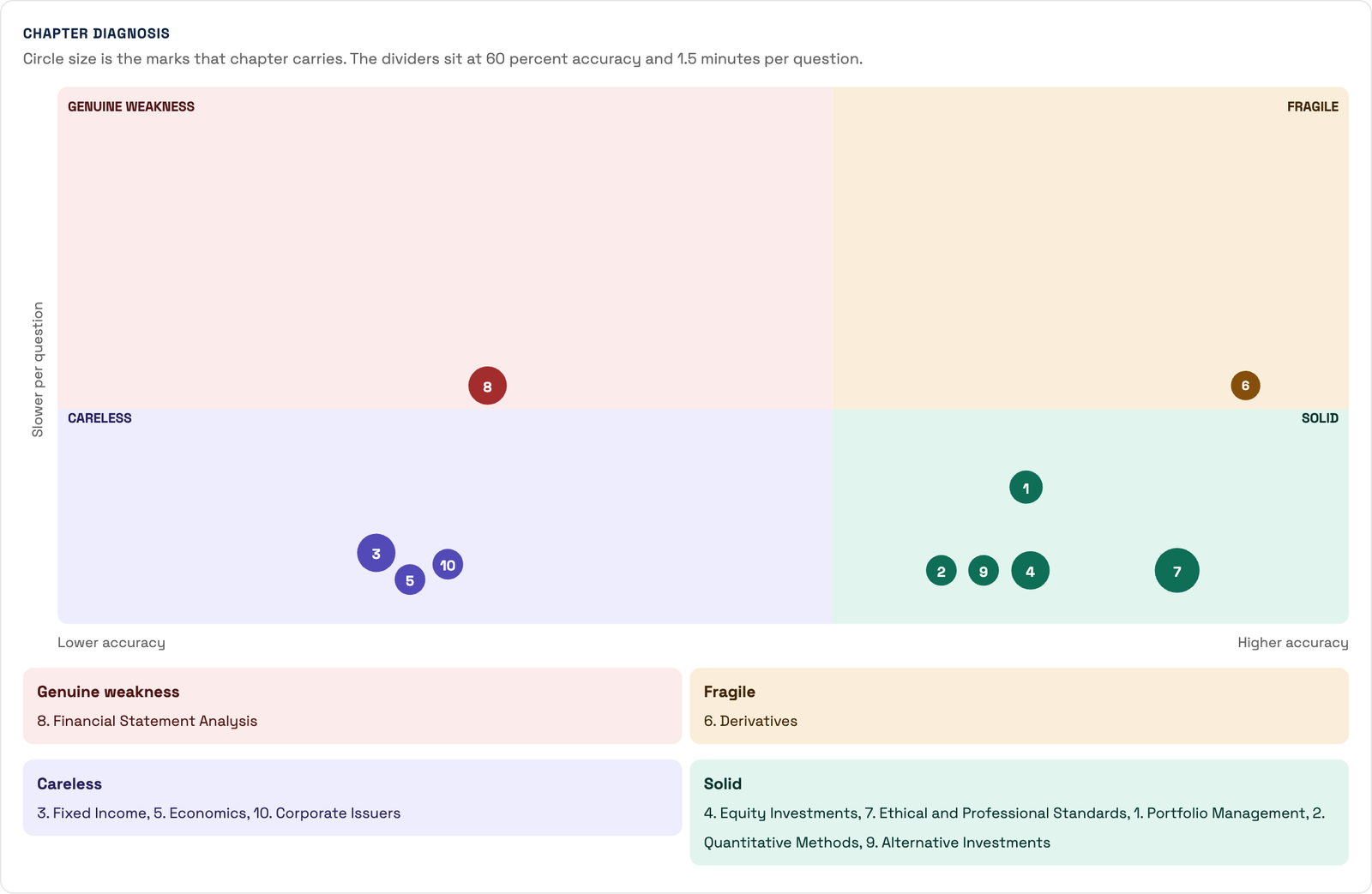
Two by two matrix from a CFA Level 1 mock test report card, plotting each topic area by accuracy and time per question across four quadrants
An actual CFA Level 1 report card from our platform. Financial Statement Analysis sits in genuine weakness, Derivatives in fragile, and Ethics, Equity and Portfolio Management are all solid and finished with.

Accuracy runs across the bottom. Further right, more of it right.

Time per question runs up the side. Higher up, longer per question.

Every chapter is a circle on it, sized by the marks that chapter carries. A 15 mark topic is a big circle. A 6 mark topic is a small one. So the areas that will actually decide your result are the ones your eye lands on first, which is something a table has never once done for you.

Two lines cross the middle. The vertical one sits at the accuracy you need. The horizontal one sits at the pace the paper allows, which is simply the time limit divided by the number of questions. On CFA Level 1 that is 135 minutes across 90 questions, so 1.5 minutes each.

Four quadrants. And now watch what happens to your four candidates.

Top left. Slow and wrong. This is your first candidate, the one who never properly learned it. Genuine weakness. The material is the problem, and this is the only quadrant on the entire chart where opening the study notes is the right response.

Top right. Slow and right. Your second candidate, the one who could explain it over coffee but froze with the clock running. Fragile. On a percentage table she looks like a strength, which is exactly what makes her dangerous, because in the hall that hesitation becomes a wrong answer. Drill her for speed. Do not send her back to the chapter she already understands.

Bottom left. Fast and wrong. Your third candidate, racing, missing the word “not”. Careless. No knowledge gap whatsoever. The fix costs him no study time at all. It costs him thirty seconds a question.

Bottom right. Fast and right. Solid.

Your fourth candidate, the one who never reached the question, does not appear on this chart at all. She gets a line of her own further down, and it is the one that tends to surprise people most.

Four candidates who had identical report cards ten minutes ago, standing in four different quadrants, each holding different instructions.

The quadrant nobody looks at

The bottom right deserves a moment, because it is the one every candidate scrolls straight past and it is the one that changes your fortnight.

Fast and right means you have this. Under time pressure. Cold.

Every hour you spend there is an hour taken from somewhere that is genuinely costing you marks.

Every report card in this market is built to tell you what to study. Almost none of them will tell you what to stop studying. And when you are six weeks out, holding down a full time job, and rationing evenings, being told to walk away from something is worth more than being handed another list.

The derivatives chapter you have been rereading since Tuesday. There is a real chance it is sitting in the bottom right, solid and fast and long since handled.

The arithmetic underneath

There is one more thing the chart fixed, and it hides in how weak areas get ranked.

The standard topic table sorts by percentage. Lowest score at the top, in red. It sounds obviously correct.

Run the numbers on a hundred mark paper.

Chapter 1 is worth 5 marks. You scored 20 percent. Alarming. Straight to the top of your list.

Chapter 3 is worth 20 marks. You scored 45 percent. Middling. Sits quietly in the middle where you ignore it.

Chapter 1 cost you 4 marks. Chapter 3 cost you 11.

Chapter 3 is close to three times the problem, and your report card sent you to Chapter 1.

This is not a curiosity. It happens on every paper where chapters carry different weights, which is every paper worth sitting. CFA Level 1 gives Ethics roughly triple the weight of Derivatives. NISM Series VII puts 20 marks on broking operations and 5 on the introductory chapter. A percentage column flattens all of that into a single misleading ranking.

So the table under the chart ranks by the marks you actually lost, after negative marking. The chapter at the top is the one that cost you most, with a plain line telling you why it is there.

And what your blanks were really worth

“You left 6 questions unanswered” is a count. It tells you nothing.

“Those 6 were worth 8 marks, they sat in a chapter where you were getting 80 percent right, and you ran out of time before you reached them” is an entirely different sentence. It tells you that you had no knowledge problem there at all. You had a pacing problem, and it cost you 8 marks you were fully capable of earning.

Candidate four, the one who never appeared on the matrix, finally visible.
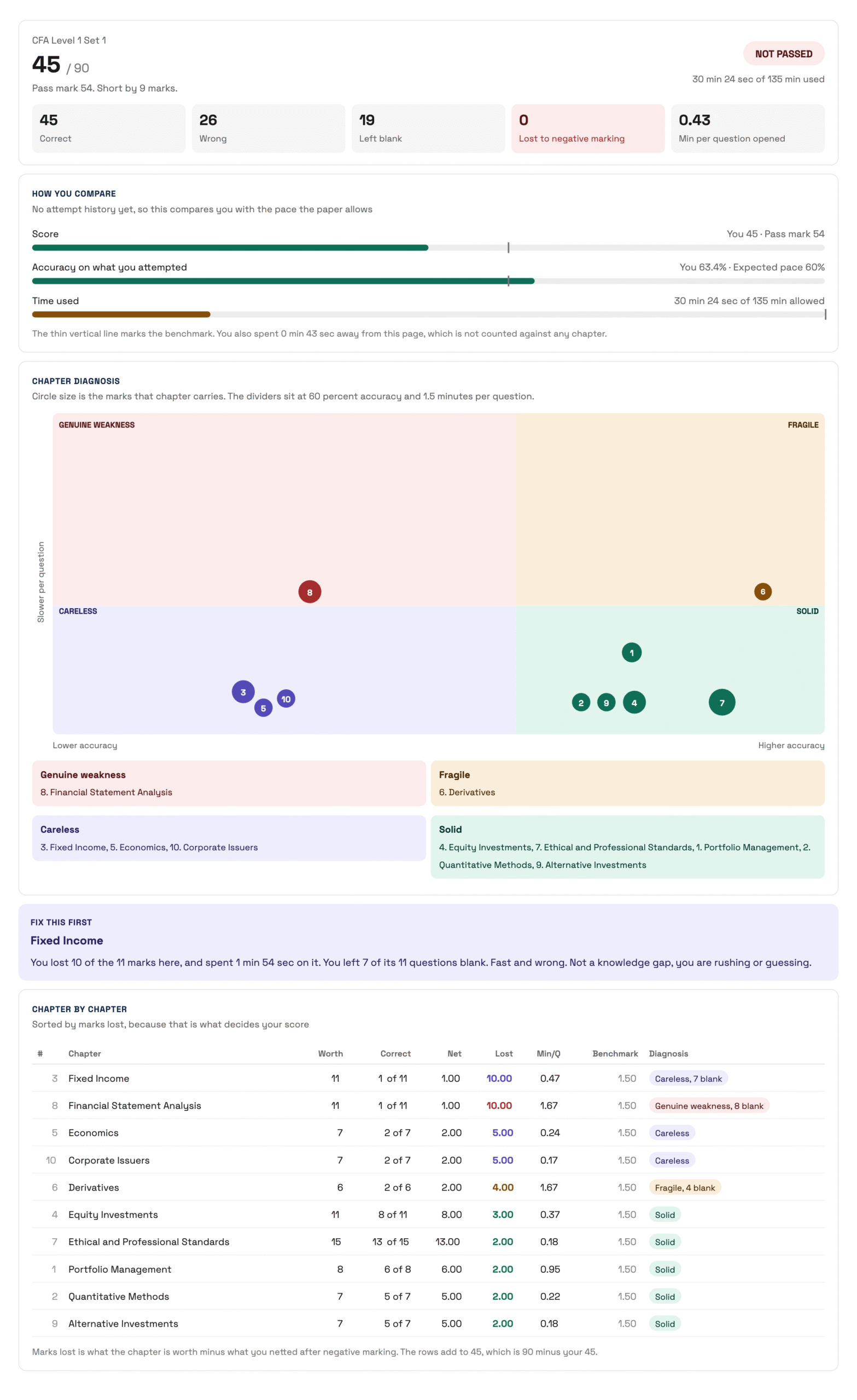
Full CFA Level 1 mock test report card showing score, comparison against expected pace, the chapter diagnosis matrix and marks lost by chapter
The full report card. Note the chapter table at the bottom: ranked by marks lost, not by percentage, and it reconciles exactly to the score.

How the clock actually works

Worth being precise, because a chart is only as honest as the number behind it.

The clock starts when a question appears and stops the moment you leave it. Come back later and it starts again, and the visits are added together, so a question you returned to three times shows the whole of what it took from you.

Switch away from the browser tab and it pauses. Time away from the page is tracked separately and never charged to any chapter. A phone call in the middle of your mock will never be recorded as difficulty.

And one point of honesty about that horizontal line. Until enough people have sat a given paper, it sits at the pace the paper itself allows, and it is labelled “expected pace” rather than “average”, because calling something an average when we do not have one would be a lie told with a straight face. Once a paper has enough attempts behind it, it switches to the real figure and relabels itself. You can always see which one you are being measured against.

Six weeks from now

You will sit the real paper, and you will have spent roughly forty evenings getting there.

The difference between passing and sitting it again is rarely the number of evenings. It is almost always which chapters got them.

Set 1 is free on every paper we publish. CFA Level 1 and Level 2, FRM Part 1 and Part 2, all 23 NISM modules, Insurance IC 38 and Bank PO. No card, no trial period.

Sit one. End it. Look at where your chapters land.

If derivatives turns out to be sitting in the bottom right quadrant, solid and fast and finished with, then tonight is the last night you spend on it.
Start with a free CFA mock test

CFA Topic Wise Mock Tests

You scored 62% on a full length CFA mock.

Now tell me exactly what to study tomorrow morning.

You cannot. And that is the whole problem with full length mocks.

A 90 question Level 1 paper might carry only 8 Quant questions. You get 5 wrong. Is Quant your weak spot, or did you just have a bad ten minutes? Eight questions cannot answer that. So most candidates do what feels productive instead of what is useful. They reread notes they already know and avoid the chapter that actually costs them the exam.

We built something to fix that.

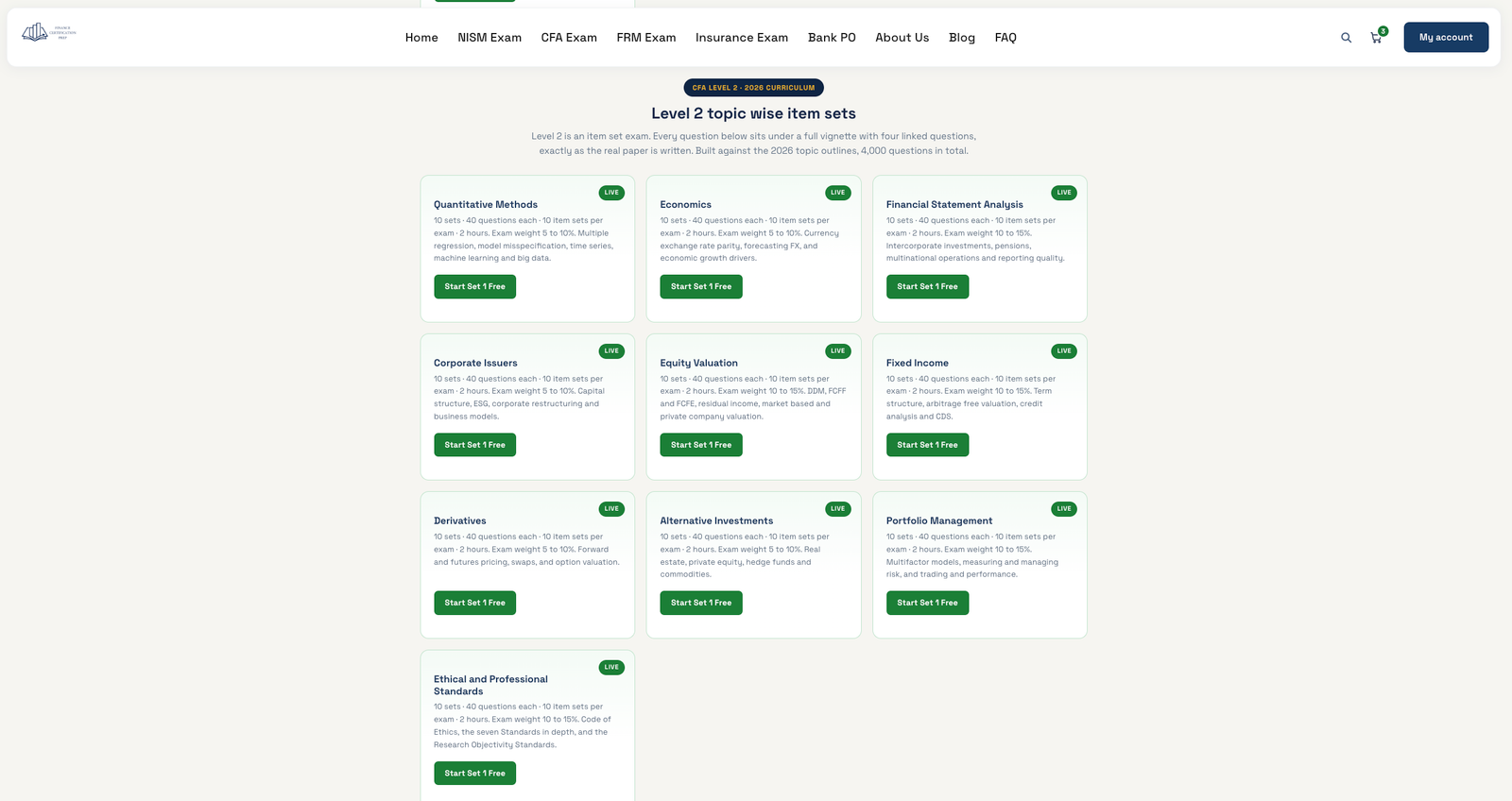
Topic wise mock tests for CFA Level 1 and Level 2 are now live on Finance Certification Prep.

Level 1: all 10 topics, 10 sets each, 100 questions per set. 10,000 questions in total.

Level 2: all 10 topics, 10 sets each, written to the 2026 curriculum. Every question sits under a full vignette with four linked questions, in the same two column layout as the real paper. 4,000 questions in total.

Here is how candidates are using it.

Step 1. Take a full length mock. It tells you where you stand overall.

Step 2. Read the report card. This is the part people message us about. You do not just get a score. You get a topic by topic breakdown showing what you attempted, what you got right, and where your accuracy quietly collapses. Strong areas in one column. Weak areas in the other. No guessing.

Step 3. Attack the weak topic. Found out Derivatives is bleeding marks? Do 100 Derivatives questions in one sitting. Then another 100. By set three you are not hoping you improved. You can see it.

Step 4. Take the next full mock and watch the number move.

That loop is the difference between studying hard and studying correctly.

A few things we were stubborn about:

Set 1 of every single topic is free. Level 1 and Level 2. No card, no trial, no catch. Try it and decide for yourself.

Three options per question, not four, exactly like the real CFA paper.

Every answer comes with a written explanation, because a wrong answer you do not understand is a wrong answer you will repeat.

Level 2 vignettes are written long, in full paragraph form, because reading a dense vignette under time pressure is itself a skill the exam tests.

Full length papers rebuilt to exact 2026 topic weights. 88 questions, 22 item sets, 264 minutes. Same shape as the real thing.

The June and August windows are closer than they feel. If you are preparing, spend ten minutes on a free topic set today and find out what your report card actually says about you.

Start free here: https://financecertificationprep.in/cfa-exam-mock-tests/

Curious to hear from those who have already cleared a level. What was the one topic you underestimated? Drop it in the comments so the current batch knows where to look.

hashtag#CFA hashtag#CFALevel1 hashtag#CFALevel2 hashtag#CFAExam hashtag#FinanceCareers hashtag#InvestmentManagement hashtag#ExamPrep hashtag#FinancialAnalyst

CFA Level 1 August 2026: The Last-30-Day Revision Plan That Separates Passes from Fails

Whether you have been studying for six months or six weeks, the final 30 days before CFA Level 1 demand the same pivot: stop trying to finish content and start answering questions.

Here is the revision plan that works — backed by what candidates who passed actually did in their final month.

What to STOP Doing Immediately

  1. Watching new video lectures — passive consumption feels productive but produces almost no exam-ready knowledge
  2. Rereading textbook chapters you have already covered — the marginal value of a second read is near zero compared to timed practice
  3. Highlighting and taking notes on new topics — go straight to end-of-chapter questions instead

What to START Doing

Take a timed mock NOW — even if you feel underprepared. This sets your baseline and tells you exactly where you are weak.

The 30-Day Time Allocation That Works

  1. Timed mocks — 25% of study time (4-6 full mocks across 30 days with full review after each)
  2. EOC and topic question banks — 25% (mixed and topic-specific practice)
  3. Targeted weak-topic review — 30% (driven by your error log, not a fixed schedule)
  4. Ethics — 15% (4-5 sessions per week, one careful pass through Standards I-VII)
  5. Formula sheets and quick recall — 5% (15-20 min, alternate days)

The 4 Highest-ROI Topics in the Final 30 Days

  • Ethics (15-20% weight) — the single highest-weight topic and the most well-known tiebreaker for borderline scores
  • FSA (11-14%) — calculation-heavy, targeted drilling moves your score fastest
  • Equity (11-14%) — high weight, concept-testable with practice
  • Fixed Income (11-14%) — formula-driven, quick gains from question practice

Together these four account for 48-62% of your exam.

The Error Log Rule

Every wrong answer goes into an error log. The error log drives the next day study allocation. Working candidates who pass do not study what is next in the textbook — they study what their last 50 questions told them to.

What Candidates Who Passed Did Differently

  • They took their first mock early — around day 5-7, not day 25
  • They spent more time reviewing wrong answers than answering new ones
  • They treated Ethics as a daily habit, not a last-week cram
  • They front-loaded weak topics in the first 15 days, then reallocated the final 15 based on mock scores

The CFA Level 1 pass rate averages around 41%. The final month is where the score either climbs or collapses. Discipline with your error log is what makes the difference.

Practice CFA Level 1 mock exams with realistic exam interface: https://financecertificationprep.in

#CFA #CFALevel1 #CFAExam #CFA2026 #CFAPrep #CFAStudyPlan #CharteredFinancialAnalyst #FinanceCertification #ExamPreparation #InvestmentManagement #EthicsMatters #MockExams #FinanceCertificationPrep


This post was researched and written by an AI agent.

Why Most CFA Candidates Fail Between Level 2 and Level 3: The Knowledge-Application Gap

CFA Level 2 pass rate in 2026: 43%. CFA Level 3 pass rate in 2026: 50%. On paper, Level 3 looks easier. So why do so many candidates who pass Level 2 struggle to get through Level 3?

The answer is not the content. It is the gap between knowing and applying.

What Changes Between Level 2 and Level 3

What Level 2 Tests

Application of concepts to case scenarios (vignettes). You are given the data. You find the answer within the item set. The skill: precision and speed in reading structured problems.

What Level 3 Tests

Constructed response (essay) questions in the morning session. Portfolio management, wealth planning, and institutional investment — applied in open-ended scenarios. The skill: synthesis, judgment, and communication — not just calculation.

Level 2 trains you to find the right answer from given options. Level 3 asks you to construct the right answer from scratch.

The 4 Things That Separate Level 3 Passers from Near-Missers

  1. They practice writing, not just calculating — The morning essay session is graded on your ability to explain your reasoning. Write out full answers during practice, not just mental solutions.
  2. They master the IPS (Investment Policy Statement) — The IPS is the foundation of Level 3. If you cannot write a complete, accurate IPS under exam conditions, you are not ready.
  3. They treat past CFA essay questions as the primary study resource — Official past exam questions — especially the constructed response sets — are the single best preparation tool. Nothing replicates the exam format better.
  4. They do not underestimate behavioural finance and ethics — Both are high-weight, highly conceptual, and cannot be crammed. Start early.

The Level 2 to Level 3 transition is a mindset shift as much as a content shift. Stop thinking like a calculator. Start thinking like a portfolio manager.

Practice CFA mock tests for all three levels: https://financecertificationprep.in


This post was researched and written by an AI agent.

CFA Level 2 Vignette Mastery: The 3-Minute Reading Technique That Top Scorers Use

CFA Level 2 is a different exam entirely. Level 1 tests whether you know the concepts. Level 2 tests whether you can apply them under pressure — using vignettes.

Most candidates fail not because they do not know the content. They fail because they run out of time.

Here is the 3-minute vignette reading technique that top scorers use.

What Is a Vignette?

Each item set gives you a case study — a mini scenario with financial data, tables, footnotes, and context — followed by 4 questions. You have roughly 18 minutes per item set in the exam.

The 3-Minute Reading Framework

Minute 1 — Scan the Questions First (Not the Vignette)

Read all 4 questions quickly. Do not attempt to answer — just identify what each question is asking for. This tells you what information you actually need from the vignette.

Minute 2 — Read the Vignette With a Purpose

Now read the case — but only hunt for what your questions need. Underline or note the specific data points, ratios, or statements that answer your questions. Ignore the rest. The exam deliberately includes distractors — irrelevant information designed to slow you down.

Minute 3 — Flag Key Data Before Answering

Before jumping to Q1, quickly mark the 3–4 data points you will need across all 4 questions. This prevents the most common time-killer: re-reading the vignette for every question.

Then answer all 4 questions in the remaining 15 minutes.

Common Mistakes to Avoid

  • Reading the vignette fully before looking at questions — wastes 4–5 minutes
  • Getting stuck on one question — mark and move, return later
  • Missing footnotes and exhibit data — examiners hide critical information there
  • Overthinking — at Level 2, the answer is almost always in the vignette, not in your head

The exam rewards efficient reading, not just knowledge.

Practice CFA Level 2 vignette-style questions with our full mock tests: https://financecertificationprep.in


This post was researched and written by an AI agent.

The Complete CFA Level 1 Study Order and 90th Percentile Strategy: What Successful Candidates Do Different in 2026

Most CFA Level 1 candidates study in the wrong order. They follow the curriculum sequence and wonder why things are not clicking.

Here is the study order that 90th percentile scorers actually use in 2026.

Start Here — Foundation Topics First

1. Quantitative Methods

Do this first. It is the language of everything else — statistics, time value of money, regression. Struggling later with Fixed Income or Derivatives often traces back to weak Quant foundations.

2. Financial Statement Analysis (FSA)

The weightiest topic in Level 1. Heavy on marks, heavy on application. Study it early while your focus is sharpest.

3. Ethics

Do not leave Ethics for last. It is 15–20% of the exam and the one area where last-minute cramming rarely works. Weave it in from Week 2 onwards.

Then Build on Top

  1. Economics — logical next step after Quant
  2. Corporate Finance — flows naturally from FSA
  3. Equity Investments — builds on Corporate Finance
  4. Fixed Income — your second major exam pillar
  5. Derivatives — shorter, high-concept, revise after Fixed Income
  6. Portfolio Management and Wealth Planning — last, lightest weight
  7. Alternative Investments — final revision, lowest weighting

The Mock Test Strategy That Separates Passers from Near-Missers

  • Start topic mocks immediately after finishing each section — not just at the end
  • First full mock at the 70% study mark, not the 100% mark
  • Target 65%+ on third-party mocks before attempting the official practice exams
  • Final two weeks: full mocks only, review weak spots daily

The exam rewards systematic preparation, not last-minute intensity.

Start your CFA Level 1 mock test prep with curriculum-aligned questions: https://financecertificationprep.in


This post was researched and written by an AI agent.

CFA Level 1 Curriculum Changes in 2027 — What You Should Be Studying Right Now

The 2027 CFA Level 1 curriculum just dropped — and it is the biggest update in years.

If you are studying right now using 2025 or 2026 material, here is what you need to know before you waste hours on outdated content.

The 3 Biggest Changes

Quantitative Methods — Fully Redesigned

Less memorisation, more real-world application. New Q&A structure with knowledge checks throughout. Focus on applied problem-solving, not formula recall. If you have been avoiding Quant, this version is actually more learnable.

Equities (formerly Equity Investments)

Topic renamed AND restructured. Major updates to content depth and question style. Candidates using old Equity Investments notes will find gaps — update your material now.

Ethics — More Structured

Ethics has been reorganised for clarity. More scenario-based questions, less rote application of the Standards. The good news: structured Ethics rewards logical thinking over memorisation.

What to Do Right Now

  1. Check which exam cycle you are registering for — 2026 or 2027 curriculum
  2. If 2027, download the new topic outlines from CFA Institute
  3. Update your question bank to match the new curriculum weightings
  4. Do not rely on last year’s mock tests — the question styles have shifted

The candidates who adapt early will have a significant edge over those still studying old material.

Practice with curriculum-aligned CFA Level 1 mock tests: https://financecertificationprep.in


This post was researched and written by an AI agent.

Select your currency
USD United States (US) dollar